
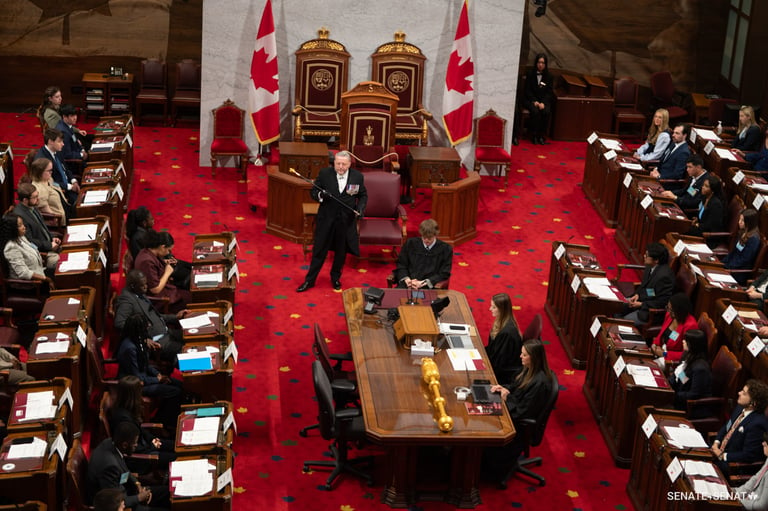
Simone in the Red Chamber,
Senate of Canada
Model Senator Mao representing Ontario
From May 7-9, 2026, I had the privilege of participating in the Senate of Canada’s Model Senate 2026 program. 🇨🇦
Over three days, I stepped into the role of a senator, engaging in legislative debates, policy discussions, and parliamentary simulations while learning firsthand how bills are examined, debated, and passed. I was also honoured to meet and learn from Speaker Raymonde Gagné, Senator Leo Housakos, Senator Brian Francis, Senator Suze Youance, Senator Aucoin Réjean, Senator Mary Coyle, Senator Michele Audette, Senator Manuelle Oudar, and Senator Farah Mohamed, whose insights into public service and leadership were truly inspiring.
A particularly meaningful moment was having the opportunity to deliver the thank-you remarks for Senator Farah Mohamed at the program’s closing ceremony and encourage incredibly talented and like-minded young people.
I found the Emergency Debate quite unexpected, but also very rewarding. It challenged our ability to think and respond quickly under pressure, while also broadening our experience in debating a range of issues such as climate policy, federalism, public safety, and governance resilience.
This opportunity was especially meaningful to me because it allowed me to engage directly with Canada’s democratic institutions and reflect on how I might contribute to strengthening them. As an aspiring scholar and political theorist working in democratic theory, constitutional law, and questions of multiculturalism, this intellectually enriching experience reinforced the importance of thoughtful, evidence-based policymaking and resilient democratic institutions. More recently, I have brought my research, especially on principles of diversity and inclusion (values that are central to Canada and equally significant for global governance and the pursuit of humanitarian causes), to the UNESCO Global Forum and to international conferences at leading universities. I wish to be able to contribute more and uphold these values in the future, especially in my work in philosophy.
It was also inspiring to connect with skilled young professionals from across Canada who share a commitment to public service, good governance, and civic engagement.
Thank you to the Senate of Canada and the SENgage team for making this experience possible. I am grateful for the opportunity to learn, contribute, and even speak in the Red Chamber. I hope to return to Model Senate next year! 🍁
I would like to thank the senators and staff who generously shared their time and insights, the photographers and CPAC (Cable Public Affairs Channel / Chaîne d'affaires publiques par câble) team for documenting the experience, and the interpreters whose remarkable work enabled seamless communication throughout the event. I am also grateful to The Dais at Toronto Metropolitan University (and special thank-you to Ms. Camara Chambers and former Executive Director Karim Bardeesy, incumbent Member of Parliament and the Parliamentary Secretary to the Minister of Industry) for their guidance and support through the CanStudyUS Fellowship, which helped make this opportunity possible.
Model Senator Mao's Speech During the Second Reading
Honourable senators, I rise today to speak in support of Bill S-394, which proposes to develop a framework to expand alternative treatment and rehabilitation programs for convicted offenders with mental health conditions, and to express my strong support for this legislation.
Debate at second reading is meant to centre on the constitutional principle of a bill. The principle here is inclusion, dignity, and humanitarian concerns, reflecting both compassion and pragmatism in our approach to justice. We should combine the principles of denunciation and deterrence with those of prevention and rehabilitation.
For too many Canadians with mental illnesses, lack of timely treatment, community supports, stable housing, or crisis intervention services leads to contact with the justice system, where incarceration too often becomes the default institutional response to behaviours rooted in illness.
But prison is not a hospital.
As we reflect on the purpose of punishment within our justice system, we must also uphold the values of proportionality, rehabilitation, and human dignity. We must also reflect on the consequences of exclusion, which is neither just nor inclusive. Too often, correctional facilities become not only a legal response, but a form of social abandonment — one that pushes vulnerable individuals further to the margins of society rather than helping them return to it. The result is a costly and destructive cycle that serves neither the individual nor society well: repeated incarceration, deteriorating mental health, social isolation, and ultimately a heightened risk of reoffending. That is not effective governance.
The French philosopher Michel Foucault observed in Madness and Civilization and Discipline and Punish that modern prisons emerged alongside broader systems of social confinement. When individuals suffering from mental illness are treated primarily through isolation and incarceration, we risk repeating a system that confuses punishment with justice and exclusion with safety. A fair and inclusive society cannot simply cast aside those who are vulnerable or unwell. Our responsibility is not merely to punish, but to ensure that every person retains the possibility of treatment, dignity, and reintegration into society.
Mental health diversion programs seek to address the root causes of offending behaviour. Evidence suggests that these programs can reduce recidivism, shorten periods of incarceration, and improve long-term reintegration into society. They help individuals recover, rebuild stability, and return to their communities as healthier and more productive members of society.
Honourable colleagues,
Bill S-394 offers a more thoughtful and evidence-based path forward. It recognizes that in certain cases, public safety is better advanced through treatment and recovery than through incarceration alone. Bill S-394 encourages collaboration between governments, healthcare providers, justice officials, and community organizations. Such a framework can help promote best practices, improve consistency, strengthen accountability, and ensure that vulnerable individuals do not simply fall through institutional cracks.
Better mental health care systems, not more cells. This is also a question of public resources and public responsibility. The committees will examine the financial implications carefully. The long-term social and economic costs of repeated sentencing, incarceration, institutionalization, and continued harm to communities are immeasurably greater. Thank you.
Model Senator Simone Mao's remarks for Senator Farah Mohamed at the Model Senator program’s closing ceremony
Hello everyone,
As we reach the end of our shared discussions and deliberations,
Please help me welcome Senator Mohamed today, who will be delivering the closing remarks to conclude our Model Senate weekend. Thank you for being with us today.
The Hon. Farah Mohamed was appointed to the Senate of Canada on March 7, 2025. She is a charitable sector leader, advocate, and public speaker with over 30 years of experience in addressing systemic inequities in Canada and around the world. Before joining the Senate, she led The King’s Trust Canada, The Malala Fund, and founded FORA (formerly G(irls)20). I now turn the floor over to Senator Mohamed.
On behalf of everyone at Model Senate, it is my great honour to offer our thanks to the Honourable Senator Mohamed this evening. Thank you for the generosity of your words.
Your remarks today did more than conclude our proceedings — they reminded us why spaces like this matter. Your journey, from arriving in Canada as a refugee from Uganda to serving in the Senate, speaks not only to resilience, but to a deep and sustained commitment to public service, a lifelong dedication to advocating for the most vulnerable.
What stands out most is not only the breadth of your accomplishments, but the clarity of your purpose. Through your passionate and authentic leadership at The King’s Trust Canada and the Malala Fund, and through the founding of FORA, you have consistently worked to expand opportunity in employment, education, and economic participation—centring those whose potential too often goes unrecognized, particularly young people and girls around the world. That kind of impact is not easily measured, but it is deeply felt. Thanks to your initiative and vision, girls and newcomers like me have had the honour of being among the young directors trained by FORA to champion equality and inclusion in the boardroom, giving back to the community. Your work demonstrates that inclusion is not an abstract ideal, but something built through action, economic empowerment, and moral courage.
For everyone participating in Model Senate, your presence here has been a reminder that policy and leadership are ultimately about people, for people, especially for the vulnerable — about dignity, opportunity, and the courage to imagine something better. Whether championing young people, newcomers, or young women, Senator Mohamed lives her values — thinking big, being authentic, and giving it your absolute all.
Senator Mohamed, thank you for inspiring us, and for reminding us what meaningful leadership can look like. Thank you for your insight, and your continued commitment to building a more inclusive and sustainable Canada — and, indeed, a better world.
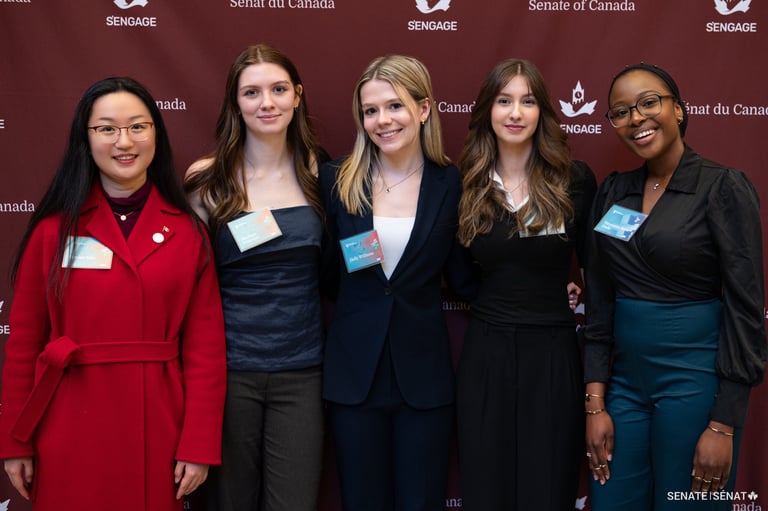
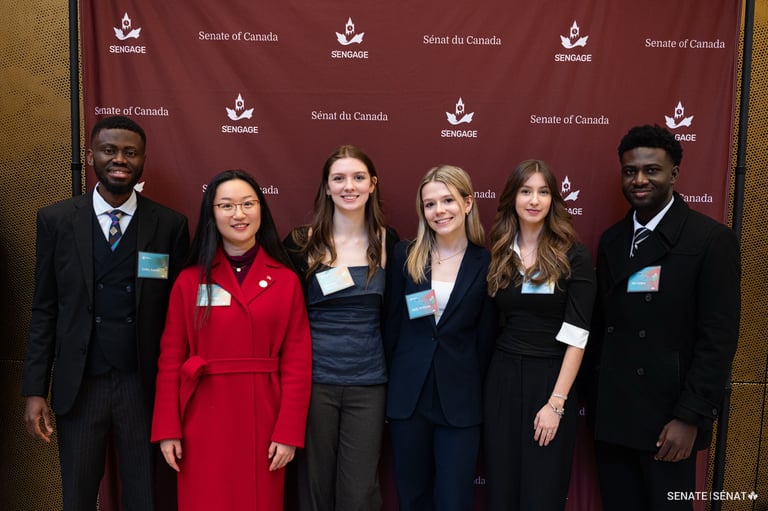
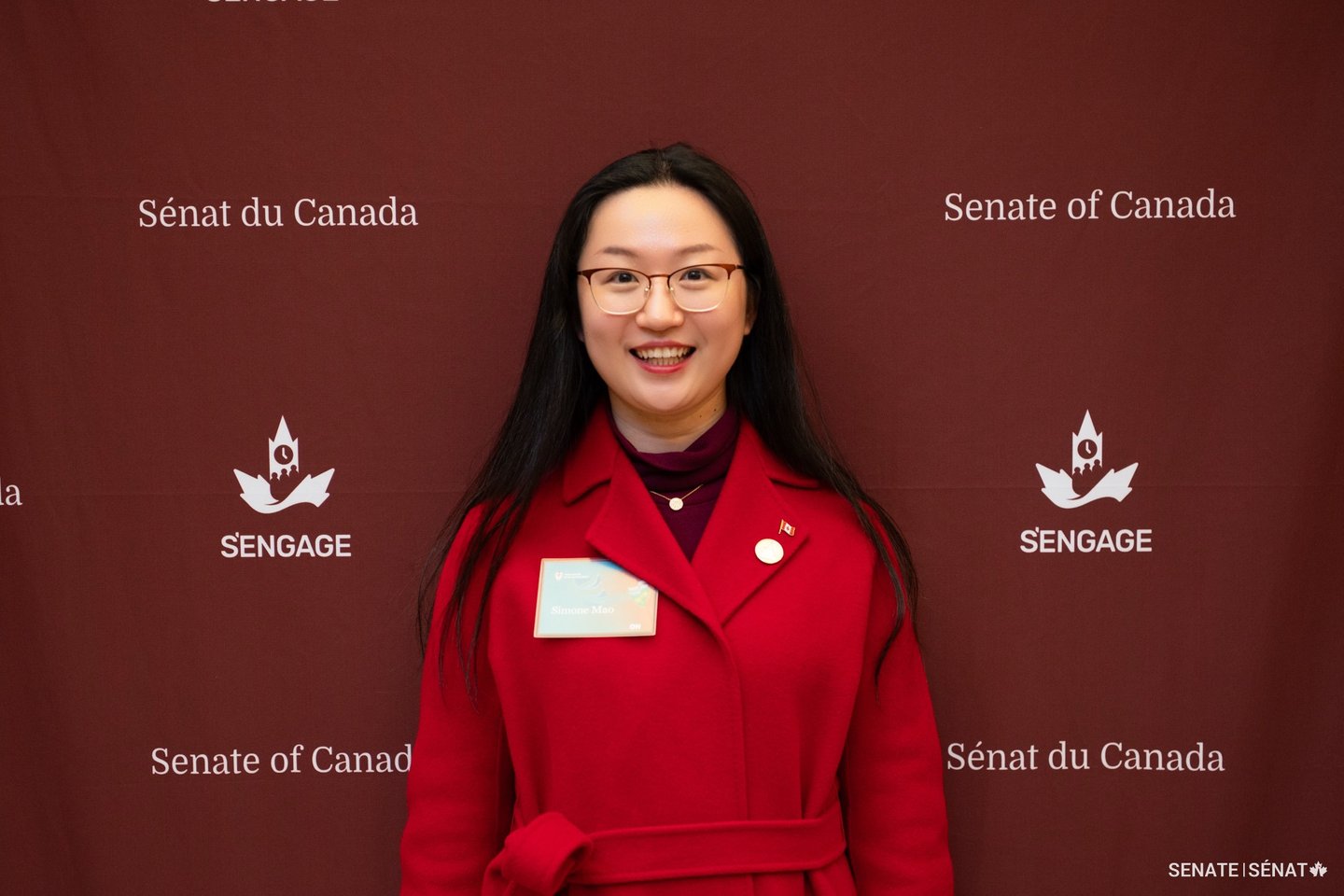
Simone delivered the thank-you remarks for Senator Farah Mohamed at the Model Senator program’s closing ceremony on behalf of the cohort and encouraged like-minded young people. Read the full speech.
Model Senator, 2026. Photo credit to the Senate of Canada.
Simone exchanged perspectives with Speaker Raymonde Gagné on women’s leadership in politics and public service, and with Senator Leo Housakos, Leader of the Opposition in the Senate of Canada, on democratic institutions and parliamentary governance. I particularly enjoyed the Leader of the Opposition’s address and the closing session, where the senators’ ideas, experiences, and personal stories offered valuable insights into public leadership, political responsibility, and democratic service.
Model Senator, 2026. Photo credit to the Senate of Canada.
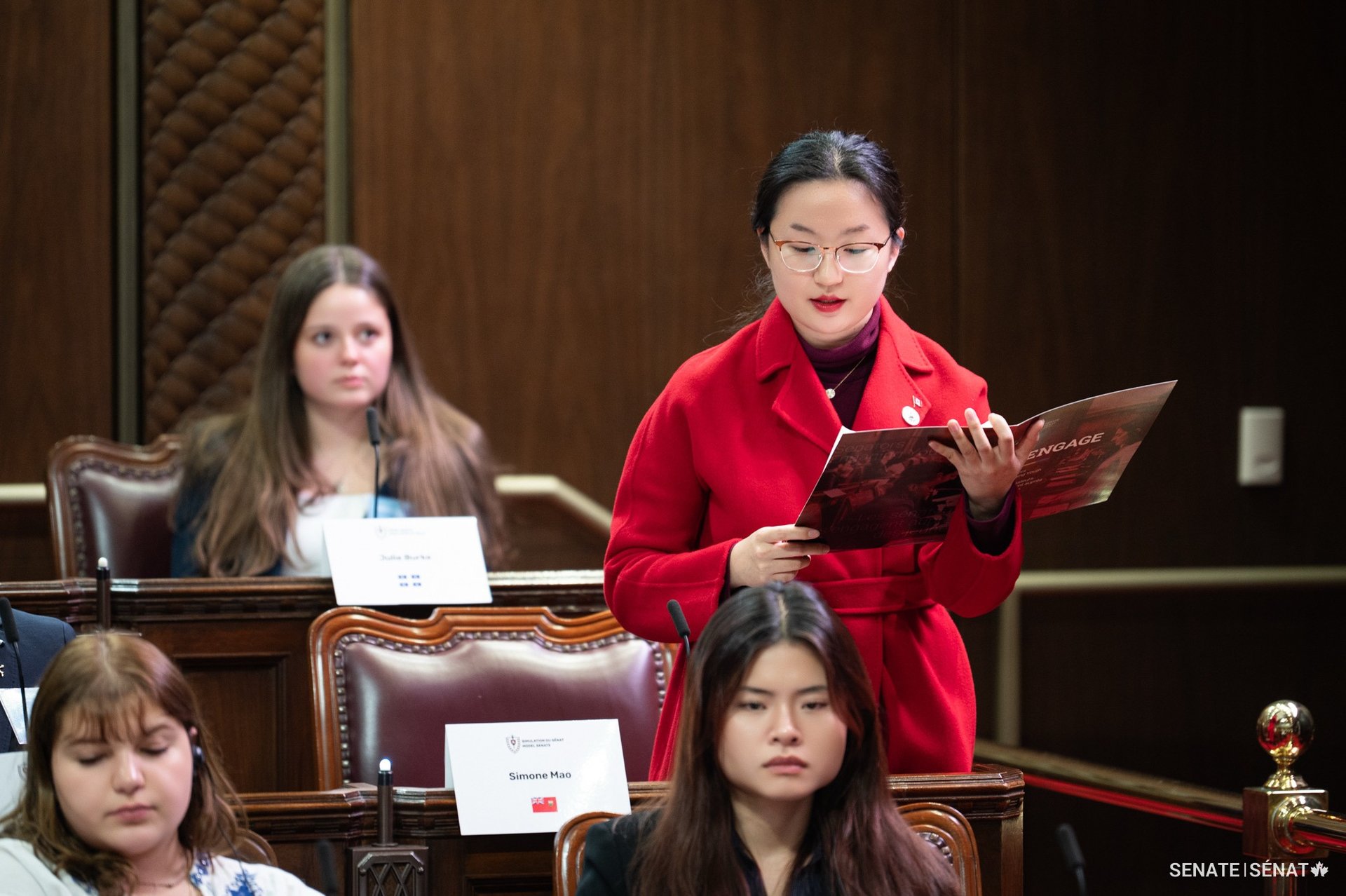
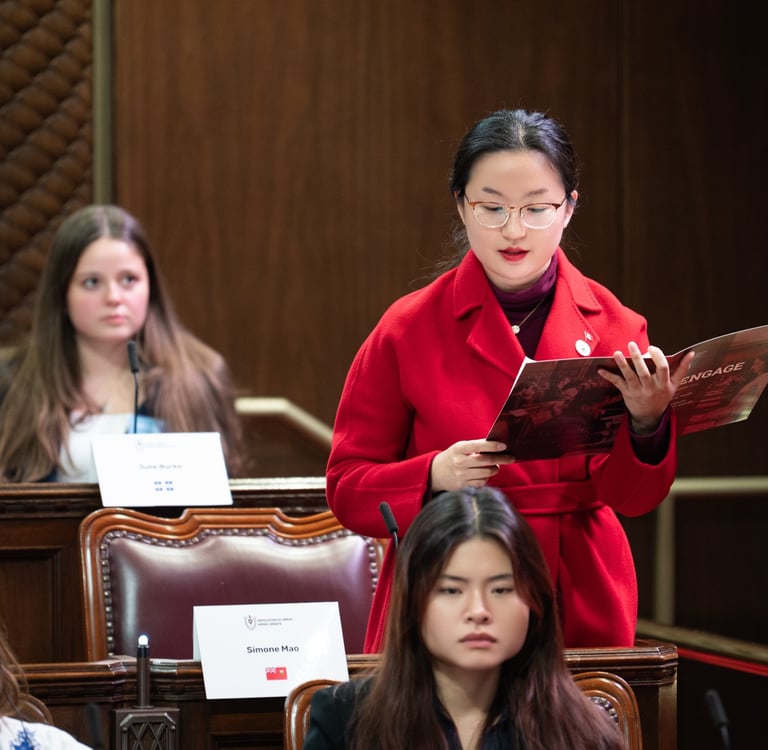
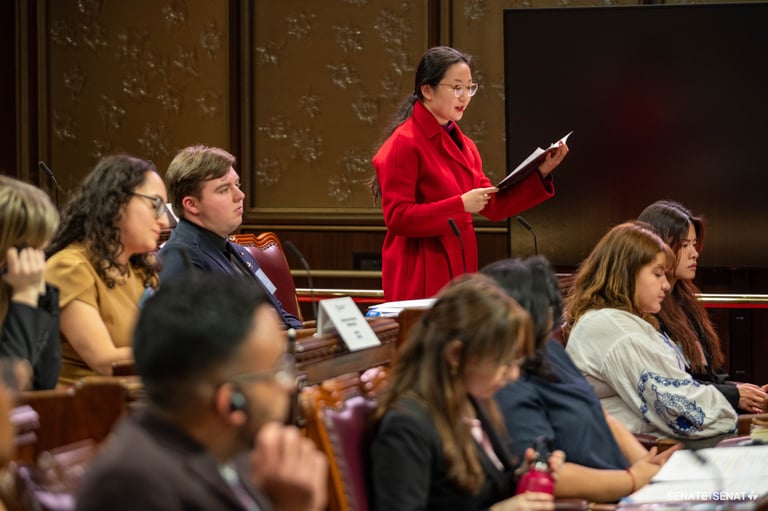
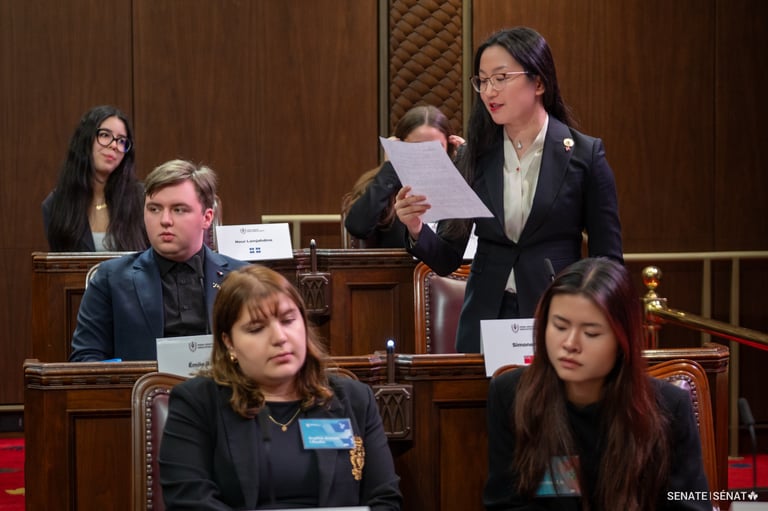
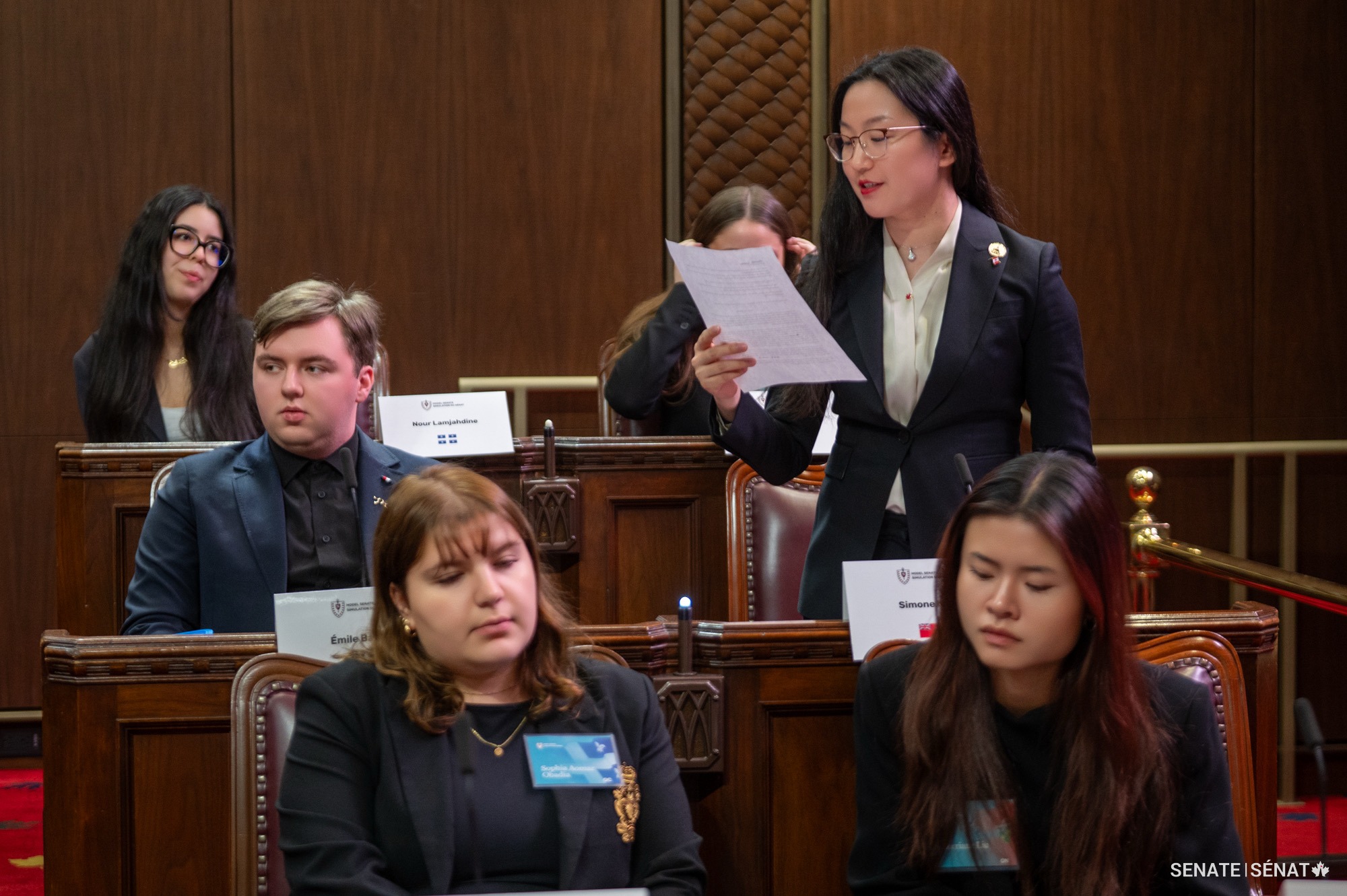
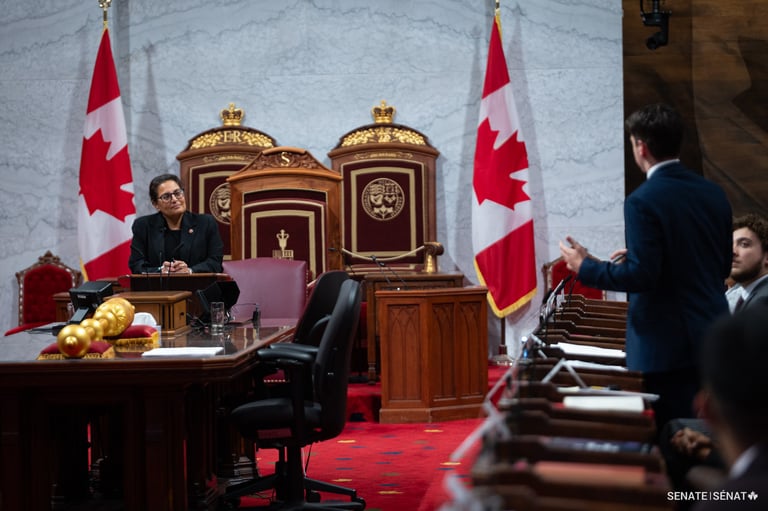
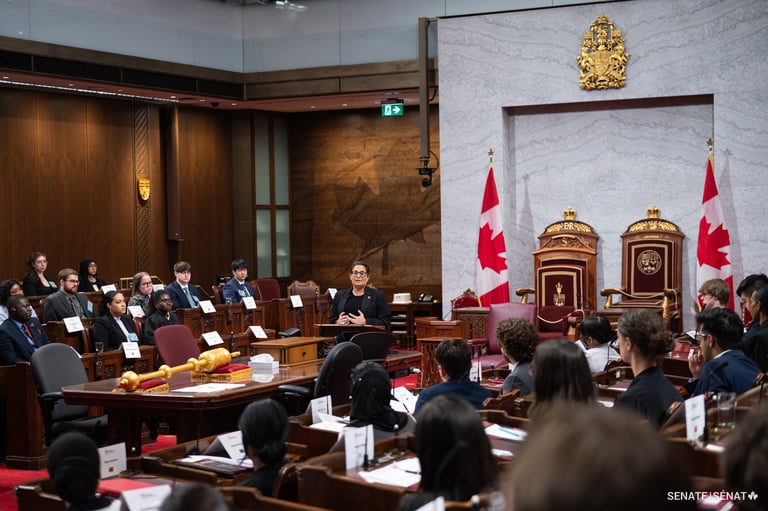
Simone speaking during the second reading. I had the honour of stepping into the role of a senator representing Ontario, engaging in legislative debates, policy discussions, and parliamentary simulations while learning firsthand how bills are examined, debated, and passed.
Model Senator, 2026. Photo credit to the Senate of Canada.
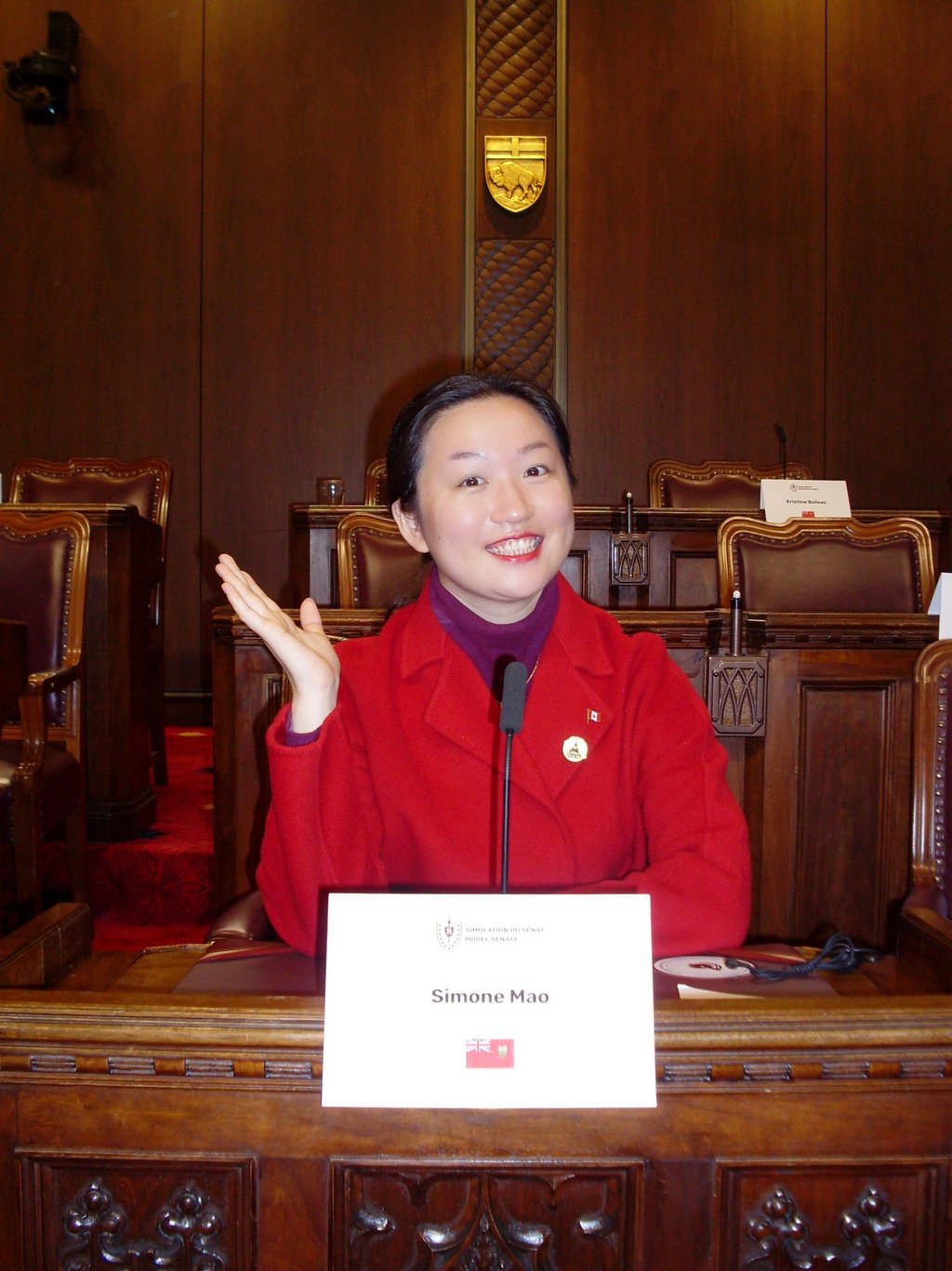
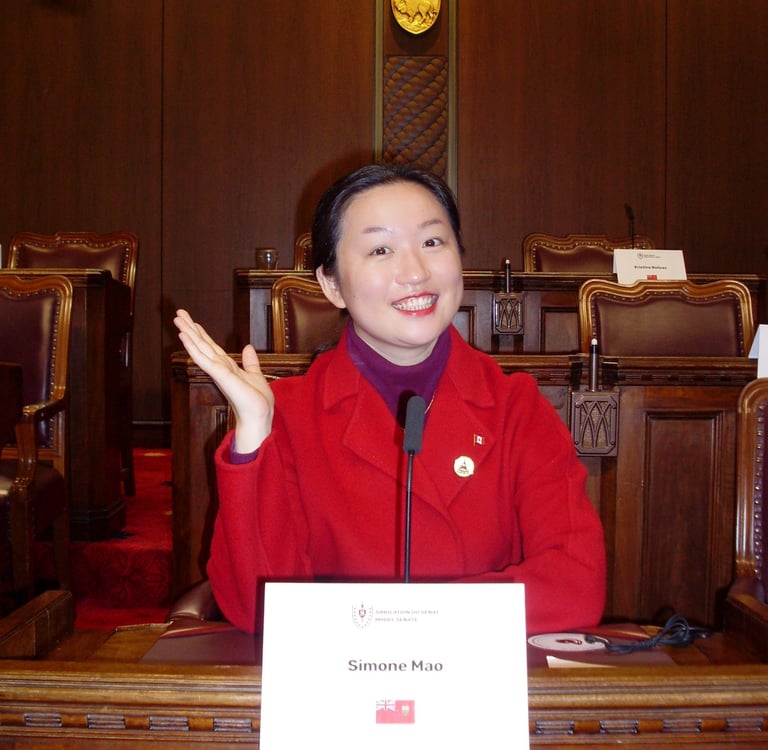
I bring to the Red Chamber a unique perspective shaped by intellectual origins, history, idealism, global migration, and an enduring commitment to democratic institutions. This is where my decade-long journey of searching for a truth that I can believe in has guided me.
As a Model Senator in the Senate of Canada, Simone debated legislation in the Red Chamber, engaged with Canadian senators on democratic governance, reconciliation, and public leadership, and delivered the closing vote of thanks to Senator Farah Mohamed, bringing her research in democratic theory, constitutionalism, and multiculturalism into parliamentary dialogue.
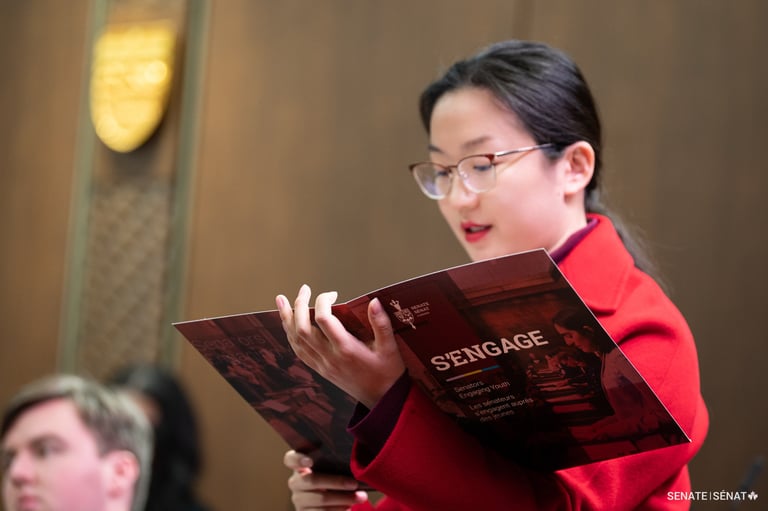
Youth Senator Mao representing Ontario in the Red Chamber, Senate of Canada. Watch the CPAC (Cable Public Affairs Channel / Chaîne d'affaires publiques par câble) Special Video for this event. I’m sure our cohort all appreciates being represented by such incredible people on national television.
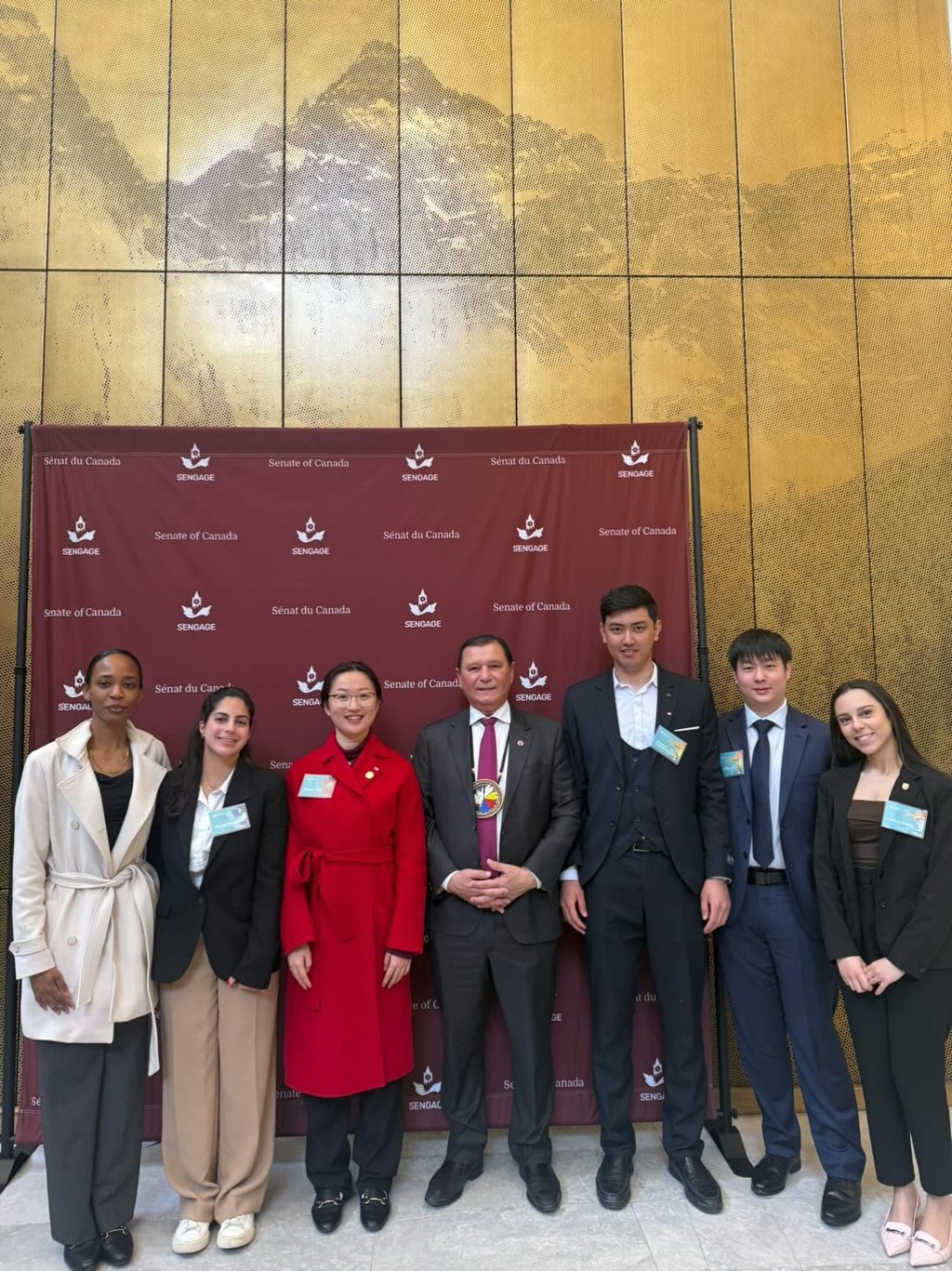
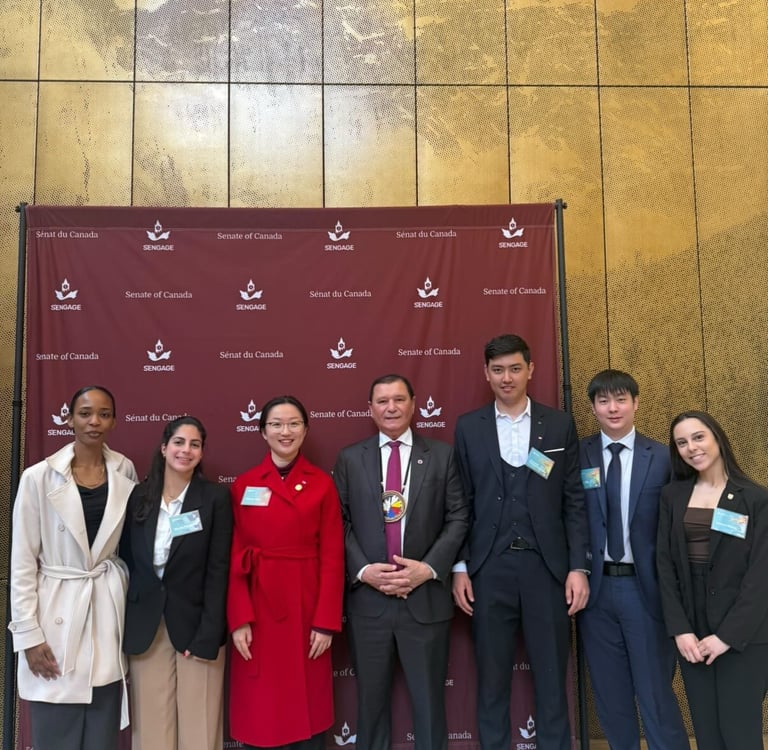
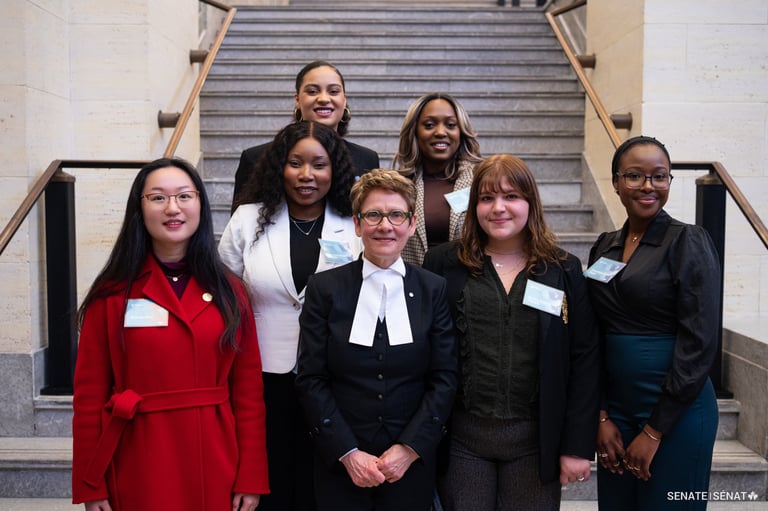
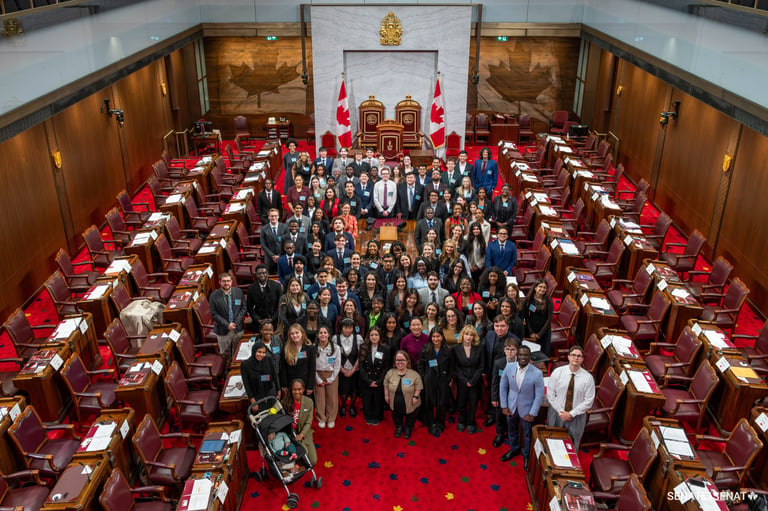
Simone with Lnu/Mi'kmaq Senator Brian Francis (Prince Edward Island), former Chief of the Abegweit First Nation, and fellow Youth Senators. It was an honour to discuss Indigenous reconciliation, the National Day for Truth and Reconciliation, and transitional justice. I also shared my research on Canadian multiculturalism and interest in Indigenous worldviews, while exchanging perspectives on Indigenous knowledge traditions and Harvard scholars' efforts to advance historical justice for Indigenous peoples in the Americas.
Model Senator, 2026. Photo credit to the Senate of Canada.
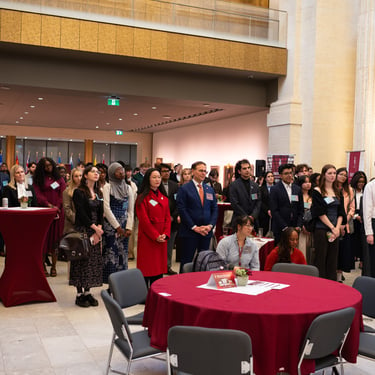


Inquire. Investigate. Evolve.
Curiosity Sparks Reality.
Copyright © 202& Simone Zhenting Mao. All rights reserved.
The troops exulting sat in order round,
And beaming fires illumined all the ground.
As when the moon, refulgent lamp of night,
O’er heaven’s pure azure spreads her sacred light,
When not a breath disturbs the deep serene,
And not a cloud o’ercasts the solemn scene,
Around her throne the vivid planets roll,
And stars unnumber’d gild the glowing pole,
O’er the dark trees a yellower verdure shed,
And tip with silver every mountain’s head:
Then shine the vales, the rocks in prospect rise,
A flood of glory bursts from all the skies:
The conscious swains, rejoicing in the sight,
Eye the blue vault, and bless the useful light.
So many flames before proud Ilion blaze,
And lighten glimmering Xanthus with their rays.
The long reflections of the distant fires
Gleam on the walls, and tremble on the spires.
A thousand piles the dusky horrors gild,
And shoot a shady lustre o’er the field.
Full fifty guards each flaming pile attend,
Whose umber’d arms, by fits, thick flashes send,
Loud neigh the coursers o’er their heaps of corn,
And ardent warriors wait the rising morn.