
Ongoing Projects
History of Political Thought; Democratic Theories; Traditions of Pluralism; Multiculturalism; AI Ethics and Governance, etc.
(An academic work habit experiment in “slow motion multitasking” in 2025 annus mirabilis.)
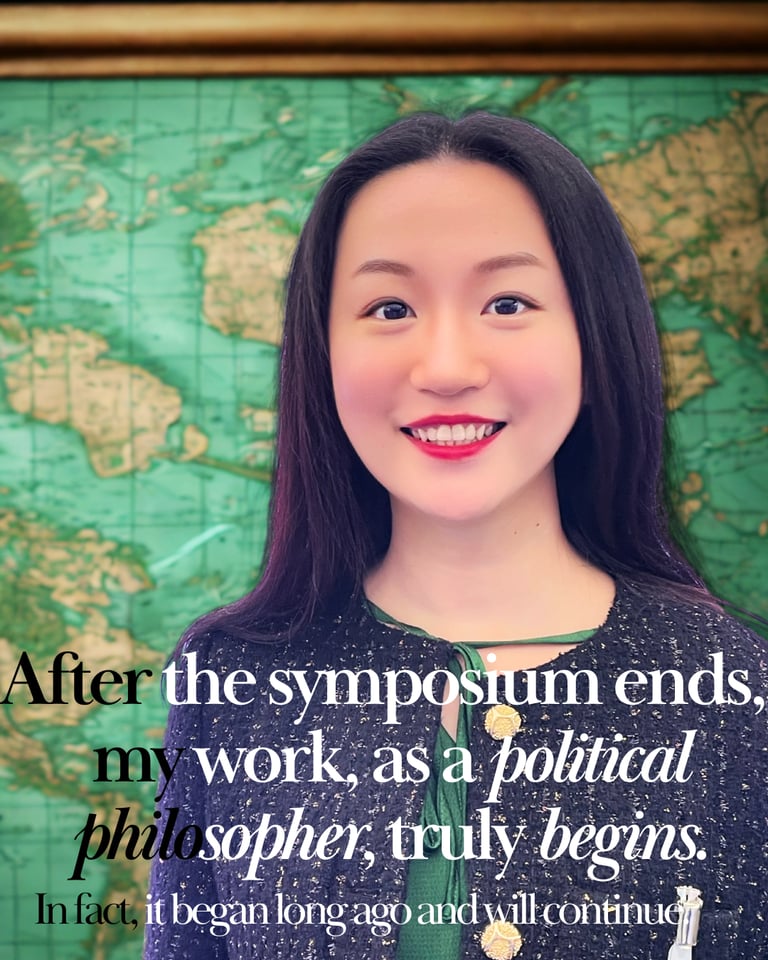
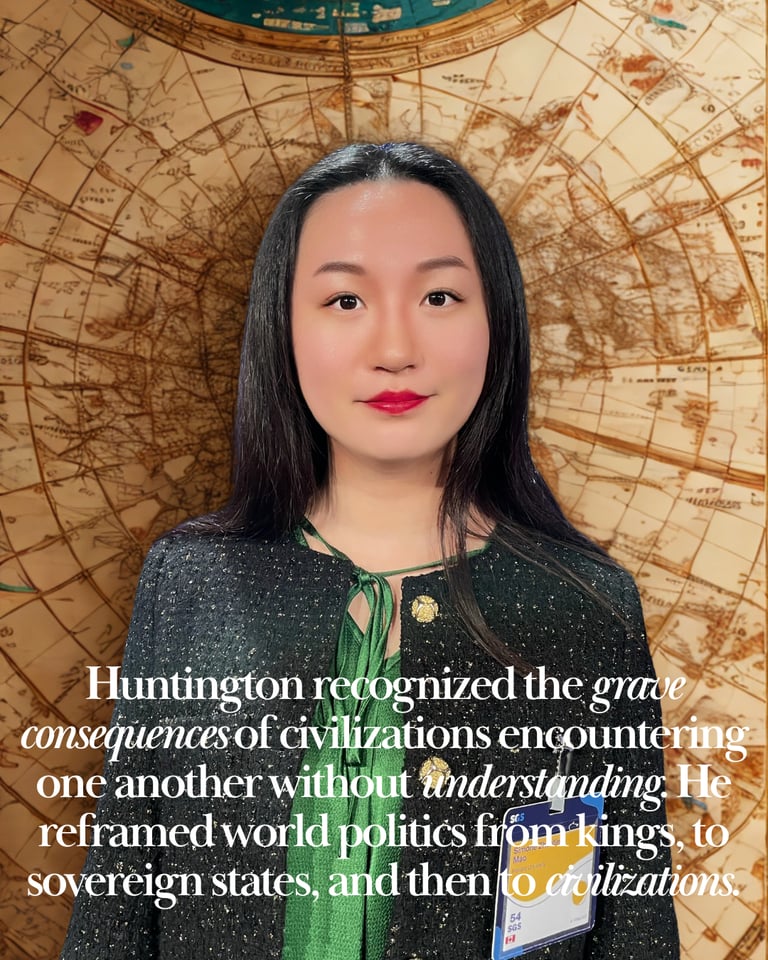
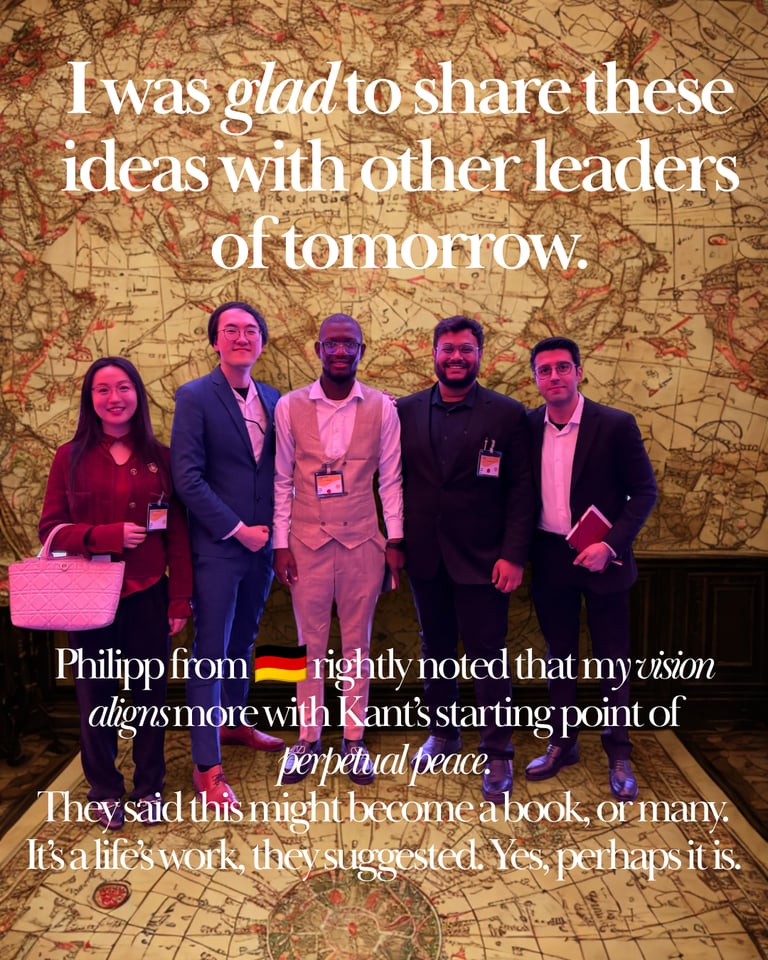
Ongoing Projects
History of Political Thought; Democratic Theories; Traditions of Pluralism; Multiculturalism; AI Ethics and Governance, etc.
(An academic work habit experiment in “slow motion multitasking” in 2025 annus mirabilis.)
Simone in the Red Chamber,
Senate of Canada
Simone Mao's Statement
I remain profoundly grateful to Canada. Here I found the principles I had long been searching for. These principles enjoy fertile soil in Canada. I appreciate that these principles were established through the Constitution and are actively defended. They are the embodiment of the values I have sought—after surviving a life-or-death ordeal, enduring cultural displacement, exclusion, and racial discrimination myself, and long reflecting upon the human history of religious wars, conflicts of belief, and potential civilizational clash. That is why I say that my departure from my origin was because of my faith, not for other reasons.
My faith is not a particular set of doctrines or religious rules, but a belief that different convictions can be expressed freely, respected sincerely, and allowed to coexist peacefully—when supported by the appropriate social and governance conditions and by sustained public endeavours. Given the opportunity, with the necessary conditions created, civilizations do not inevitably clash. Such a multicultural faith is built on trust, dialogue, mutual understanding, and collective efforts across generations.
I deeply appreciate it as Canadians provide an inclusive environment in which my ideas can grow and flourish. They were the first to recognize my work, share my ideals, and offer me a home after my ordeals, displacement, and tumultuous journey across continents. I believe that many people from the seven God’s continents who cherish peace and human dignity will one day recognize my work and ideals as well. I’m humbly grateful that they have been recognized by UNESCO.
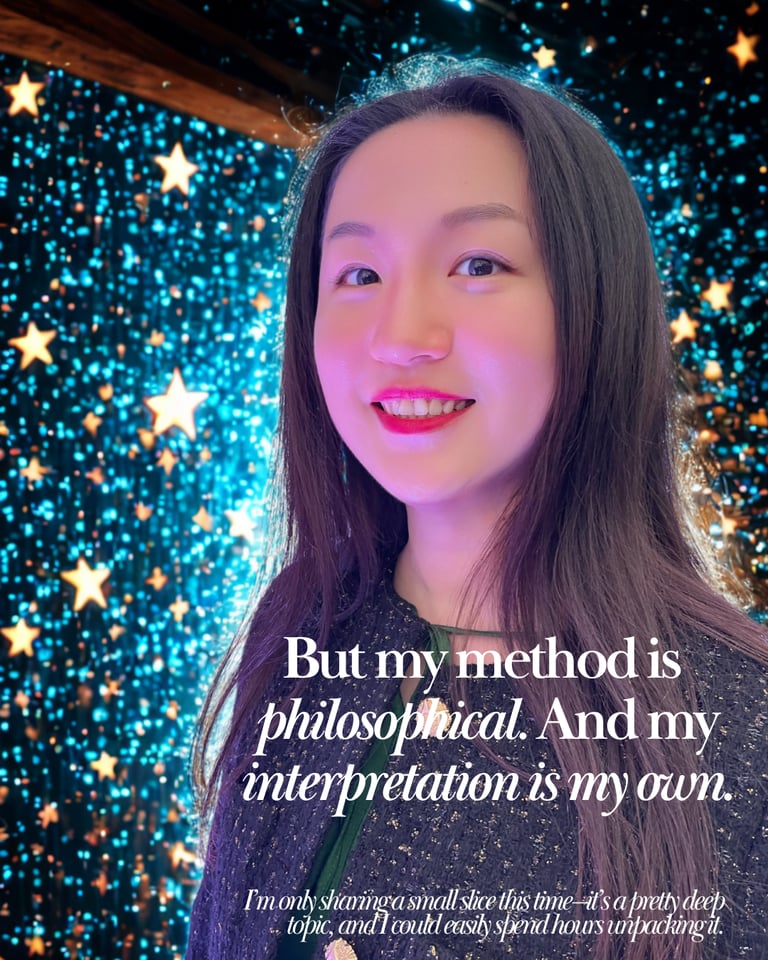
My way of thinking and my system of beliefs are unlike anyone else’s. I do not accept others projecting their own assumptions, upbringing, or worldview onto me, nor do I accept being interpreted through that lens. As Spinoza observed, people’s various dispositions and love of contradiction cause them to be habitually inclined to distort and condemn what differs from their own accustomed ways of thinking, however rightly it may have been said. Every church is orthodox to itself, yet often seen by others as erroneous or heretical. Part of human nature inclines us to gather instinctively among those who resemble ourselves while remaining reluctant to understand those whose convictions or identities differ from our own.
From an evolutionary perspective, this tendency likely reflects adaptations that favoured cooperation within small, closely bonded groups. It is a legacy of humanity’s tribal instincts rather than an immutable law of our future. Nothing in human life remains unchanged. The Stone Age brain could not have imagined the technologies that now shape our daily existence. Evolution has shaped our predispositions. It continues to unfold, as new social realities create new selective pressures, giving rise to new adaptive dispositions. One of the most significant adaptations of our increasingly interconnected world may be the ability to cooperate across differences of culture, faith, and identity. Not only for addressing global challenges, but it may, in the distant future, become the new norm of human living. If our ways of living can change so profoundly, there is little reason to regard any certain inherited tendency as an unalterable essence of a vague, elusive, equivocal “human nature,” just as there is little justification for essentialism in our understanding of cultures.
Like Spinoza, I have never forgotten how differences in thought and values can become so profound and grave. The inevitability of my departure from home has demonstrated how deep and ingrained human attachment to long-held convictions that only they alone are right can be. Yet being deep-rooted is not being wise. The future belongs to a world that is prepared to learn, in earnest, how to live with otherness and with its neighbours. It belongs to civilizations that possess both the will and the capacity to respect difference.
When the vision you seek to realize is unlike anything people have ever encountered, when the possibilities you envision lie beyond people’s previous experience, and they have never imagined, they naturally interpret it through the lens of what they already know, projecting familiar categories and their own assumptions onto it and, in doing so, misunderstanding it. Yet the future is always something to be created. Fortunately, people’s lived experiences, the governance, constitutional, and cultural practices of countries such as Canada, Switzerland, and the Netherlands, and others, provide valuable points of reference and living blueprints for such a future that may be imagined and built.
Simone's View about Her Emigration and Sacrifices Safeguarding Her Ideas
Chinese tradition often emphasizes one’s belonging and attachment to the native soil—“fallen leaves eventually return to their roots”. But why not learn from the Jewish people, who offer another model: culture can be carried wherever one goes. Civilization, essentially, is not bound to any one territory but resides in the living peoples who embody it. It endures wherever there are people who inherit it, live by it, and pass it on. The wisdom some peoples have cultivated through centuries of diasporic life might offer a valuable example for an increasingly pluralistic and interconnected world where more and more individuals and peoples dwell side by side as neighbours, not bound to certain territories.
In exile, Confucius traveled among the principality states for fourteen years in pursuit of his political and moral ideals. At the courts of these states, he expounded his political beliefs; though he did not see them implemented, his journeys disseminated the traditions of li (which orders human relationships) and wen (which cultivates human beings) across the Chinese world, attracted many disciples, and laid the foundations for a moral vision emphasizing personal and governmental morality, harmonious social relationships, righteousness, kindness, sincerity, and a ruler’s responsibilities to lead by virtue during an age of incessant warfare, profound political and social transformation, and the erosion of the moral order. During his travels, he endured the siege at Kuang and later the starvation between Chen and Cai. Whether threatened with death or reduced to hunger, he never abandoned his commitment. In the siege at Kuang, he called upon Heaven:
“If Heaven intends to let this civilizing tradition (wen) perish, then those who come after me will no longer be able to participate in its tradition and share in its blessings. If Heaven does not intend to let this culture (wen) perish, what can the people of Kuang do to me?”
「天之將喪斯文(wen)也,後死者不得與於斯文(wen)也;天之未喪斯文(wen)也,匡人其如予何?」
The inscription derived from Confucius’s appeal to Heaven within the Harvard-Yenching Library reads “Si Wen Zai Zi” (斯文在兹)—“Here abides the living tradition/continuity of civilization.” The term wen (文) does not refer merely to literature, nor simply to culture. It refers to the civilizing tradition inherited from the Zhou, and generally speaking, (self-)cultivation, the moral and cultural order, and the enduring transmission of human cultivation and education itself. In comparative perspective, it can be rendered as the Humanities in certain contexts, and bears affinities with the Greek concepts of paideia and the German ideal of Bildung, while also sharing with nomos (Ancient Greek: νόμος) the idea of a normative cultural order. The Book of Changes (Zhouyi, Hexagram 22, Bi 賁) also states: “By observing the patterns of human culture (renwen), one transforms and brings order to the world.”
「觀乎人文以化成天下。」
Confucius was a reformist. He broke the state’s hereditary monopoly on education by founding a private school open to students from diverse social backgrounds. Like Socrates, he was a great educator. He believed that learning should be open to all regardless of social origin (you jiao wu lei, “education for all, without discrimination”). He transformed education from a privilege of the aristocracy into an opportunity available to people of talent and aspiration regardless of birth, and his pedagogy varies according to each student’s character and capacity. For this reason, Taiwan commemorates Confucius’s birthday as Teachers’ Day. Like Confucius, in my own understanding, the cultivation of character, the right to education should be open to all regardless of nation-state and ethnicity, and learning knows no boundaries.
Simone's View
俯仰不愧天地,功過自有春秋。
“I stand unashamed before Heaven and Earth. My merits and my faults belong to the judgment of history.” Only Heaven—Providence—can pass final judgment on my deeds.
重生之我是王猛,在二十一世紀上半葉,兼濟天下。
王猛,是打破華夏蠻夷正統觀念的先行者。
I told my professor in Global Ethnic Politics that, one day, I’d like to write a book on a remarkable period of Chinese history—from Wang Meng (325-375, often called the "Zhuge Liang of the North"), the chancellor of the Former Qin who helped unify northern China after the prolonged fragmentation following the Western Jin dynasty, to Yuwen Tai 宇文泰, the de facto ruler and paramount general of the Xianbei-led Western Wei.
This era, often regarded as China’s second great age of fragmentation and integration, lasted for more than three and a half centuries, from the collapse of the Han dynasty in AD 220 to the founding of the Sui dynasty in AD 581. Some of the defining forces that shaped this period were economic development, large-scale ethnic coexistence and integration, state-/nation-building, and cultural fusion. States were not only competing for territory but also grappling with the challenge of addressing ethnic and cultural conflicts, governing increasingly diverse populations, and forging new political communities.
I find this period especially compelling because many of its central questions resemble those confronting our own age. Globalization has intensified hybridity, migration, and cultural interaction, making ethnic coexistence, nation-building, and effective governance among diverse societies some of the defining challenges of the twenty-first century. The institutional innovation and political wisdom developed during this historical period, therefore, offer valuable insights into contemporary ethnic politics, peaceful coexistence, and institutional design.
Chinese history and Asian Studies have historiographical traditions. I hope to approach this period from a fresh perspective grounded upon modern interdisciplinarity—bringing together ethnic politics, comparative political theory, and the study of forms of government and governance.
Of course, this is simply an intellectual project I enjoy contemplating in my spare time.
Wang Meng can be understood as a pioneering political thinker and statesman who moved beyond the conventional Huaxia(a historical concept of the Chinese nation)–barbarian dichotomy as the dominant framework of political legitimacy. In this sense, he is a predecessor to my vision. His vision of governance rested less on ethnic identity than on political order, administrative capacity, and the integration of diverse peoples.
His life and statesmanship—particularly his decision to decline office under the Jin dynasty and later to become the chancellor of Emperor Fu Jian—invite comparison with the story of Polybius (my Harvard supervisor said so when I told him my story), who developed a vision of a universal history (likewise, Wang Meng sought to lay the political foundations for a reunified, multiethnic order).
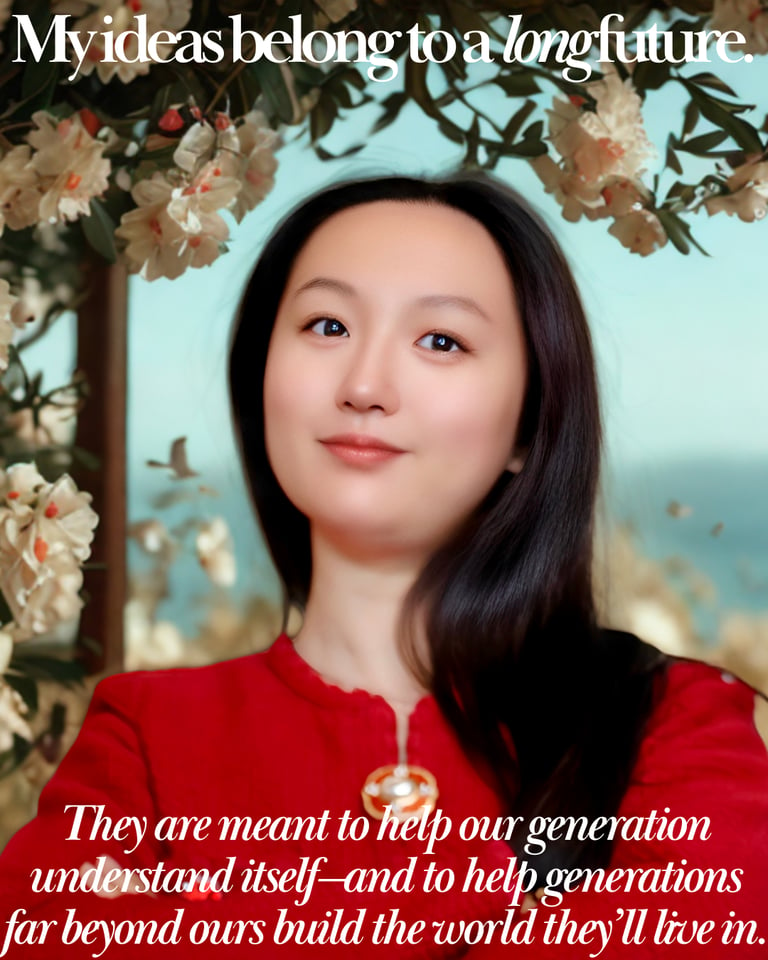
My ideas are not the problem.
They are simply ahead of their time.
When humanity reaches the highest summit, the flag we raise should be the flag of humanity, of our shared Earth.
青梅煮酒論英雄【論制度創新的天才】
On Geniuses of Institutional Innovation
——不知你怎麼評價秦始皇。我們今天關於「他本人」所知的一切都被銷除了,我們不知道他的生平、人格、思想【對,欲以「君門高九重」的幕後形象示人】。對於嬴政,我們只能就他的經歷事件、政績與後世影響來評價。
——了不起。變「封建五爵,井田刑獄」為大一統帝國中央集權郡縣制,是應對從奴隸制向封建制過渡的時代需要,當之無愧的「第一次制度創新」的天才,將商鞅、韓非的思想卓有成效地施政。並天下、稱皇帝、廢分封、置郡縣、征百越、逐匈奴、修長城、通溝渠、遷富豪、車同軌、書同文、行同倫、一法度、統一度量衡——「車轍馬跡,經緯四極。於鑠賢聖,總統邦域。」
——對。皇帝尊號的創立者,有如奧古斯都對於古典世界的意義。始皇是第二,沒有人是第一。
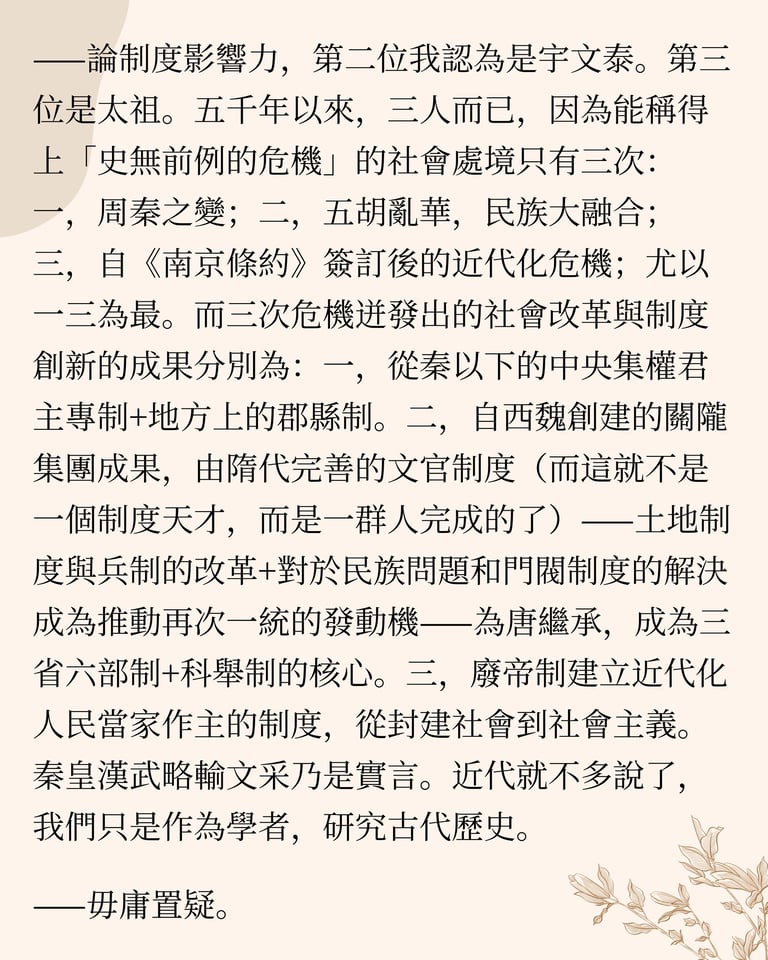
——論制度影響力,第二位我認為是宇文泰。第三位是太祖。五千年以來,三人而已,因為能稱得上「史無前例的危機」的社會處境只有三次:一,周秦之變;二,五胡亂華,民族大融合;三,自《南京條約》簽訂後的近代化危機;尤以一三為最。而三次危機迸發出的社會改革與制度創新的成果分別為:一,從秦以下的中央集權君主專制+地方上的郡縣制。二,自西魏創建的關隴集團成果,由隋代完善的文官制度(而這就不是一個制度天才,而是一群人完成的了)——土地制度與兵制的改革+對於民族問題和門閥制度的解決成為推動再次一統的發動機——為唐繼承,成為三省六部制+科舉制的核心。三,廢帝制建立近代化人民當家作主的制度,從封建社會到社會主義。秦皇漢武略輸文采乃是實言。近代就不多說了,我們只是作為學者,研究古代歷史。
——毋庸置疑。
——這麼看宇文泰世無其二。先將均田制、府兵制、六官制緊密聯合成一體,解決了土地所有權、兵源、統治基礎的問題,統治階層與被統治階層、兵與民、中央與地方的利益緊密關聯。着重在於府兵制,采鮮卑舊八部制,立八柱國,實為六軍,精妙設計了從八柱國、十二大將軍、二十四開府、儀同領兵的統屬關係,聯合了西魏皇族、原關中胡化漢人、六鎮等漢化胡人、入關諸將等不同集團。
你往細節看宇文泰部署的精妙。八柱人選根據各自的背景來照顧各個方面的勢力,在人事格局上具體精心地進行安排,分割了他們的實力,在他們中間形成平衡的態勢。將各派系的首領由單純的軍事首領上升到西魏朝廷的政治貴族,滿足了他們由邊疆鎮將躋身於開國元勛的政治野心;將軍事與土地貴族聯合,取得關隴地區地方豪強的支持,並有力地控制他們,以便有效地控制關隴地區。哪個柱國控制哪兩位大將軍,根據各自統轄的地區來看,也構成了相互牽制、避免軍閥獨大的局面。宇文泰在各實力派之中雖然相當於兄長的地位,但實際上各派卻具有平起平坐的聯盟性質。
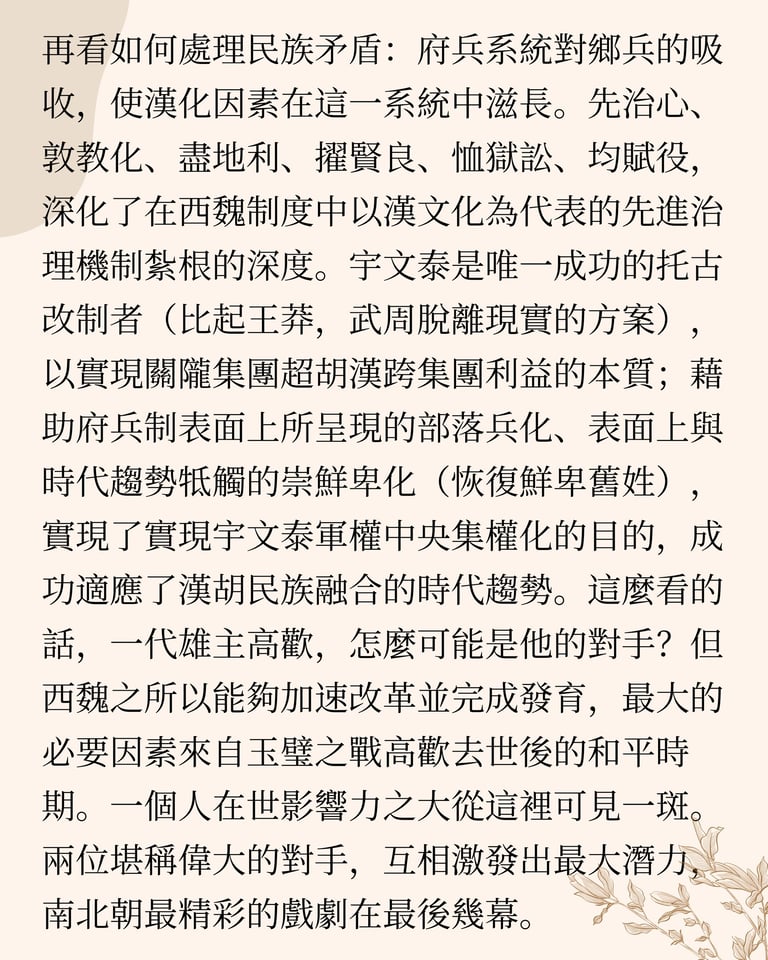
再看如何處理民族矛盾:府兵系統對鄉兵的吸收,使漢化因素在這一系統中滋長。先治心、敦教化、盡地利、擢賢良、恤獄訟、均賦役,深化了在西魏制度中以漢文化為代表的先進治理機制紮根的深度。宇文泰是唯一成功的托古改制者(比起王莽,武周脫離現實的方案),以實現關隴集團超胡漢跨集團利益的本質;藉助府兵制表面上所呈現的部落兵化、表面上與時代趨勢牴觸的崇鮮卑化(恢復鮮卑舊姓),實現了實現宇文泰軍權中央集權化的目的,成功適應了漢胡民族融合的時代趨勢。這麼看的話,一代雄主高歡,怎麼可能是他的對手?但西魏之所以能夠加速改革並完成發育,最大的必要因素來自玉璧之戰高歡去世後的和平時期。一個人在世影響力之大從這裡可見一斑。兩位堪稱偉大的對手,互相激發出最大潛力,南北朝最精彩的戲劇在最後幾幕。
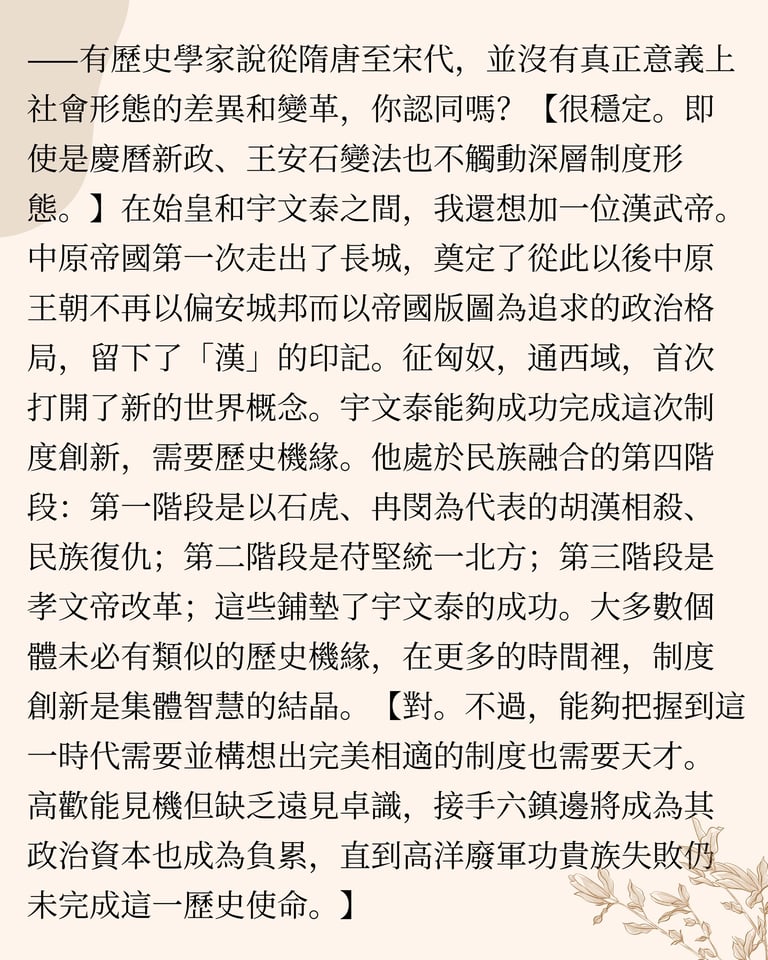
——有歷史學家說從隋唐至宋代,並沒有真正意義上社會形態的差異和變革,你認同嗎?【很穩定。即使是慶曆新政、王安石變法也不觸動深層制度形態。】在始皇和宇文泰之間,我還想加一位漢武帝。中原帝國第一次走出了長城,奠定了從此以後中原王朝不再以偏安城邦而以帝國版圖為追求的政治格局,留下了「漢」的印記。征匈奴,通西域,首次打開了新的世界概念。宇文泰能夠成功完成這次制度創新,需要歷史機緣。他處於民族融合的第四階段:第一階段是以石虎、冉閔為代表的胡漢相殺、民族復仇;第二階段是苻堅統一北方;第三階段是孝文帝改革;這些鋪墊了宇文泰的成功。大多數個體未必有類似的歷史機緣,在更多的時間裡,制度創新是集體智慧的結晶。【對。不過,能夠把握到這一時代需要並構想出完美相適的制度也需要天才。高歡能見機但缺乏遠見卓識,接手六鎮邊將成為其政治資本也成為負累,直到高洋廢軍功貴族失敗仍未完成這一歷史使命。】
——在宇文泰之後,可以加一個元朝——"Pax Mongolica" 概念是令人驚訝的,商品、技術和文化在一個帝國之間暢通無阻,在此前這是難以想象的,忽必烈治下的蒙古統治具有的世界性塑造了新的社會面貌。我們討論了很多北朝雄主,一些歷史學家說,南朝沒有大一統的機會,在這方面我不這麼悲觀。你怎麼看?
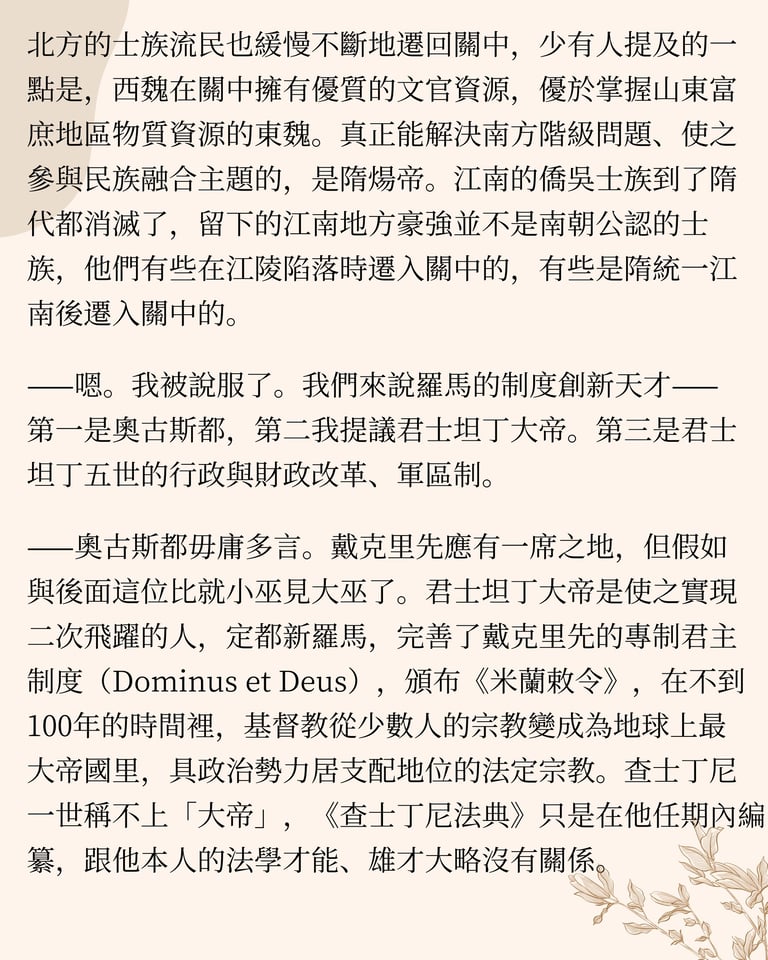
——南朝不可能統一中原,完成歷史使命。你需要看一個時代最緊要的主題:那就是民族大融合和門閥制度問題。——南朝結束時的士族與晉代衣冠南渡、南朝剛開始的士族不是一批士族,但是南朝門閥制度始終缺乏自我革新的動力,直到陳;但最重要的是南朝沒有歷史條件直面民族問題,無法完成統一。孫恩起義以後,門閥自身已沒有能力擔任統治階層,士庶區別越嚴格越代表門閥制度的衰弱。但在北方,大族郡姓政治勢力的衰落在六鎮起義之後,(根據《通典》所正確指出的)真正打破了清濁官界線的正是因為宇文泰恢復六官制,手段次一等也勉強達到打破了自漢朝以來大族豪強勢力掌握地方政權的效果的,是齊後主通過賣官鬻爵、出賣地方掾屬的方案。
北方的士族流民也緩慢不斷地遷回關中,少有人提及的一點是,西魏在關中擁有優質的文官資源,優於掌握山東富庶地區物質資源的東魏。真正能解決南方階級問題、使之參與民族融合主題的,是隋煬帝。江南的僑吳士族到了隋代都消滅了,留下的江南地方豪強並不是南朝公認的士族,他們有些在江陵陷落時遷入關中的,有些是隋統一江南後遷入關中的。
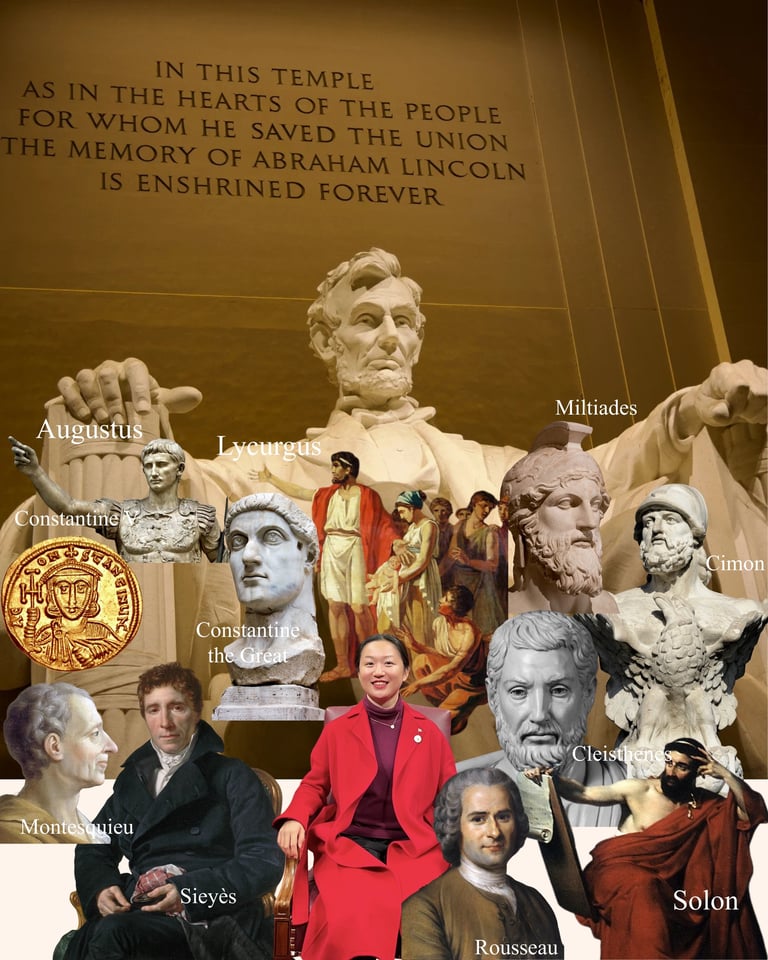
——嗯。我被說服了。我們來說羅馬的制度創新天才——第一是奧古斯都,第二我提議君士坦丁大帝。第三是君士坦丁五世的行政與財政改革、軍區制。
——奧古斯都毋庸多言。戴克里先應有一席之地,但假如與後面這位比就小巫見大巫了。君士坦丁大帝是使之實現二次飛躍的人,定都新羅馬,完善了戴克里先的專制君主制度(Dominus et Deus),頒布《米蘭敕令》,在不到100年的時間裡,基督教從少數人的宗教變成為地球上最大帝國里,具政治勢力居支配地位的法定宗教。查士丁尼一世稱不上「大帝」,《查士丁尼法典》只是在他任期內編纂,跟他本人的法學才能、雄才大略沒有關係。
——The genius institutional architects of ancient Greece: Solon, Cleisthenes, Cimon, Miltiades, and the legendary Lycurgus. [Hear, hear.]
制度,制度,制度。
I love to build.
——我們今天的時代仿佛希臘化時代「宇宙城邦」面臨的倫理和政治衝擊。與君士坦丁一世所處的社會環境相比較,我認為如果有人能夠解決世界多元化倫理原則,全球公民權與移民問題,民族與宗教自由,以及全球化世界中個人和國家的互聯責任問題,無論從理論上,還是實踐上,一次良好的解決方案定會具有劃時代的意義。距我們較近的時代裡理論家已為此鋪設了道路,多國實踐培育了土壤。往本質說,它不但事關政治哲學,更需要政治科學,其亦是政治神學。
——戴克里先、君士坦丁五世真正想做的事情,同時代也沒有多少人能夠理解這兩位君主的雄才大略。需要的不是完全的「理解」,而是他們成功地將一批人聯合起來致力於這一遠景並順利運作。
齊安集
擬古
「居異國(原作:見天子)庸知非福,何兒女悲乎?」
短歌行
癸卯年三月(2023)久未長吟,夢中得意。
採薇山之阿,泛舟江中流。一道恆思弘,百代德其周。
天地惟以人,鏗然立軌則。黎庶恢繁息,幽明糾黜陟。
明明揚仄陋,稷下無遺滯。於鑠賢聖儀,嗟哉後失製。
失製有窮達,沈節各異計。叔夜累羈縻,許由推讓世。
順時徒逆勢,政出不由己。君子必見機,得慮在知止。
伯夷欲厲俗,仲父希良士。轍軌馳如市,經緯心如水。
紛葩陶朱公,三遷有榮名。履方處圓智,滔盪一槎輕。
持盈天與動,獨愛世之英。千秋功業畢,識時善治生。
煌煌靈芝華,三秀生何奇。介志其能與?斂翼候長吹。
按:轍軌馳如市,經緯心如水:《漢書·鄭崇傳》:「臣門如市,臣心如水。」
斂翼候長吹:《晉書·王猛》:「猛瑰姿俊偉。博學好兵書,謹重嚴毅,氣度雄遠,細事不干其慮,自不參其神契,略不與交通,是以浮華之士咸輕而笑之。猛悠然自得,不以屑懷。少游於鄴都,時人罕能識也。惟徐統見而奇之,召為功曹。遁而不應,遂隱于華陰山。懷佐世之志,希龍顏之主,斂翼待時,候風雲而後動。桓溫入關,猛被褐而詣之,一面談當世之事,捫虱而言,旁若無人。」
紛葩陶朱公,三遷有榮名;持盈天與動;三秀生何奇:《史記·卷四十一·越王勾踐世家第十一》:「蠡對曰:『持滿者與天,定傾者與人,節事者以地。』故范蠡三徙,成名於天下,非茍去而已,所止必成名。太史公曰:范蠡三遷皆有榮名,名垂後世。」《集解》:韋昭曰:「與天,法天也。天道盈而不溢。」虞翻曰:「人道尚謙卑以自牧。」韋昭曰:「時不至,不可強生;事不究,不可強成。」
採薇山之阿;煌煌靈芝華,三秀生何奇;失製有窮達:嵇叔夜《幽憤詩》:「窮達有命,亦又何求。煌煌靈芝,一年三秀。採薇山阿,散髮巖岫。永嘯長吟,頤性養壽。」
千秋功業畢,識時善治生;君子必見機,得慮在知止:《越絕書·越絕德序外傳記第十八》:「范蠡因心知意,策問其事,卜省其辭,吉耶凶耶?兆言其災。夫子見利與害,去於五湖。蓋謂知其道,貴微而賤獲。易曰:知幾其神乎?道以不害為左。傳曰:知始無終,厥道必窮。」又滔盪一槎輕:《吳越春秋》:「蠡復為書遺種曰:『吾聞天有四時,春生冬伐;人有盛衰,泰終必否。知進退存亡而不失其正,惟賢人乎!蠡雖不才,明知進退。……可與共患難,而不可共處樂;可與履危,不可與安。』……乃乘扁舟,出三江,入五湖,人莫知其所適。」
履方處圓智:《新唐書·卷139》:說請賦「方圓動靜」,泌逡巡曰:「願聞其略。」說因曰:「方若棋局,圓若棋子,動若棋生,靜若棋死。」泌即答曰:「方若行義,圓若用智,動若騁材,靜若得意。」又《史記·卷四十一·越王勾踐世家第十一》:會稽典錄云:「范蠡字少伯,越之上將軍也。本是楚宛三戶人,佯狂倜儻負俗。文種為宛令,遣吏謁奉。吏還曰:『范蠡本國狂人,生有此病。』種笑曰:『吾聞士有賢俊之姿,必有佯狂之譏,內懷獨見之明,外有不知之毀,此固非二三子之所知也。』」
一道恆思弘;沈節各異計:曹操《善哉行》(其一):「古公亶甫,積德垂仁。思弘一道,哲王於豳。伯夷叔齊,古之遺賢。讓國不用,餓殂首山。晏子平仲,積德兼仁。與世沈德,未必思命。」介志其能與:《善哉行》(其二):「雖懷一介志,是時其能與!」持盈天與動:《善哉行》(其三):「持滿如不盈,有德者能卒。」
百代德其周:周道。《詩經·檜風·匪風》:「顧瞻周道,中心怛兮。」
曹操《度關山》:「天地間,人為貴。立君牧民,為之軌則。車轍馬跡,經緯四極。黜陟幽明,黎庶繁息。於鑠賢聖,總統邦域。封建五爵,井田刑獄。有燔丹書,無普赦贖。皋陶甫侯,何有失職?嗟哉後世,改制易律。勞民為君,役賦其力。舜漆食器,畔者十國,不及唐堯,采椽不斫。世嘆伯夷,欲以厲俗。侈惡之大,儉為共德。許由推讓,豈有訟曲?兼愛尚同,疏者為戚。」
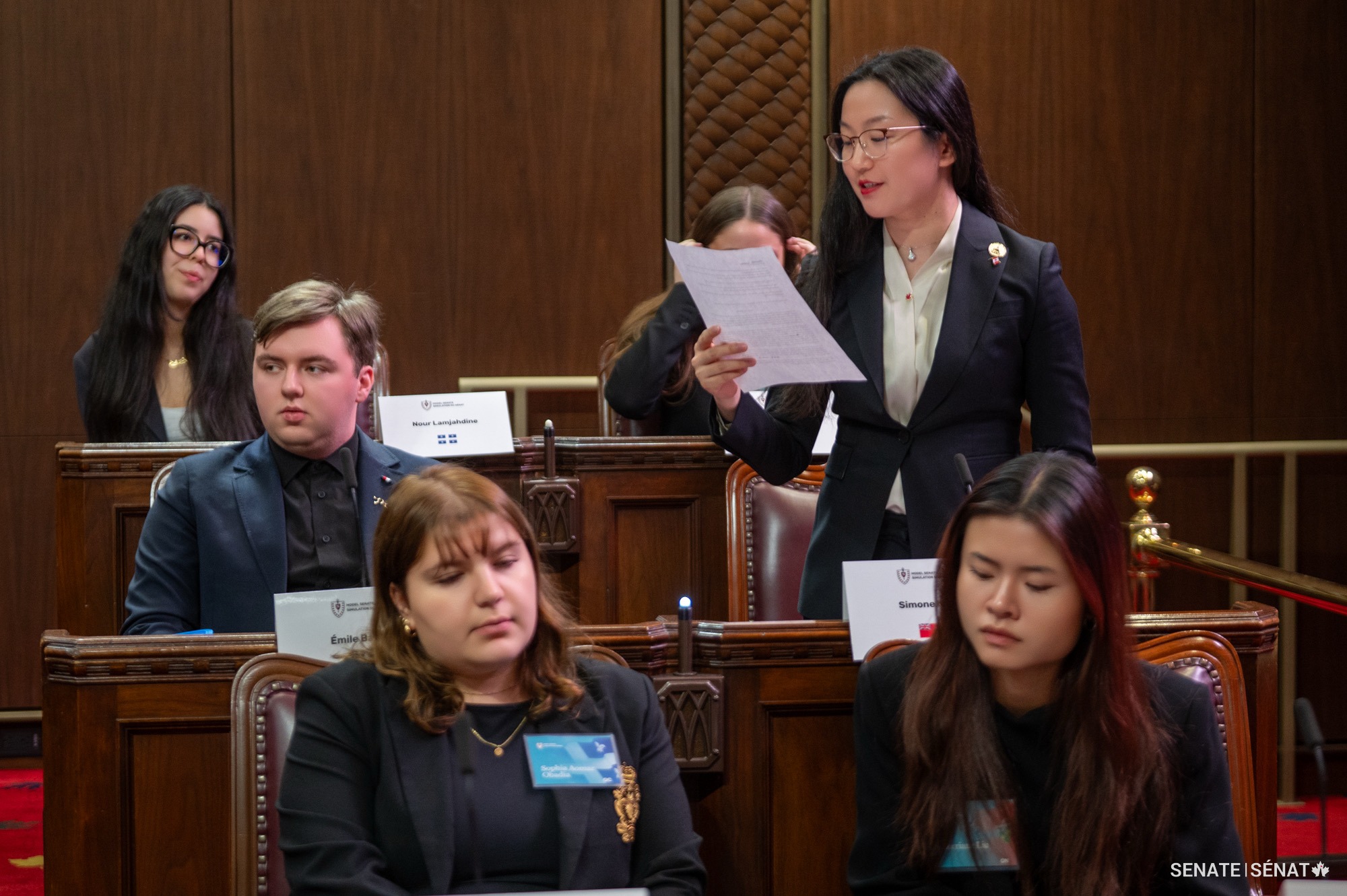
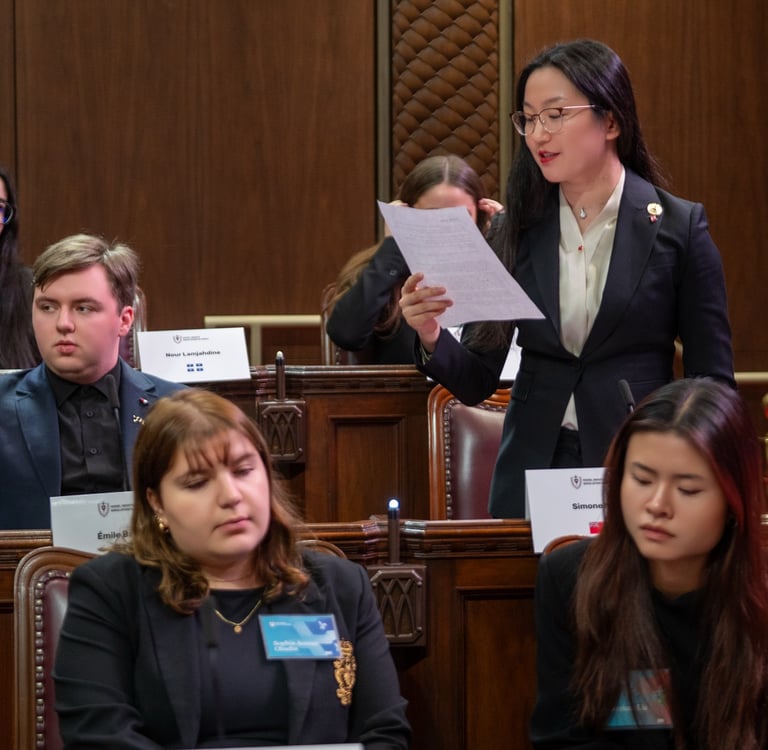
Simone delivered the thank-you remarks for Senator Farah Mohamed at the Model Senator program’s closing ceremony on behalf of the cohort and encouraged like-minded young people. Read the full speech.
Model Senator, 2026. Photo credit to the Senate of Canada.
Simone exchanged perspectives with Speaker Raymonde Gagné on women’s leadership in politics and public service, and with Senator Leo Housakos, Leader of the Opposition in the Senate of Canada, on democratic institutions and parliamentary governance. I particularly enjoyed the Leader of the Opposition’s address and the closing session, where the senators’ ideas, experiences, and personal stories offered valuable insights into public leadership, political responsibility, and democratic service.
Model Senator, 2026. Photo credit to the Senate of Canada.
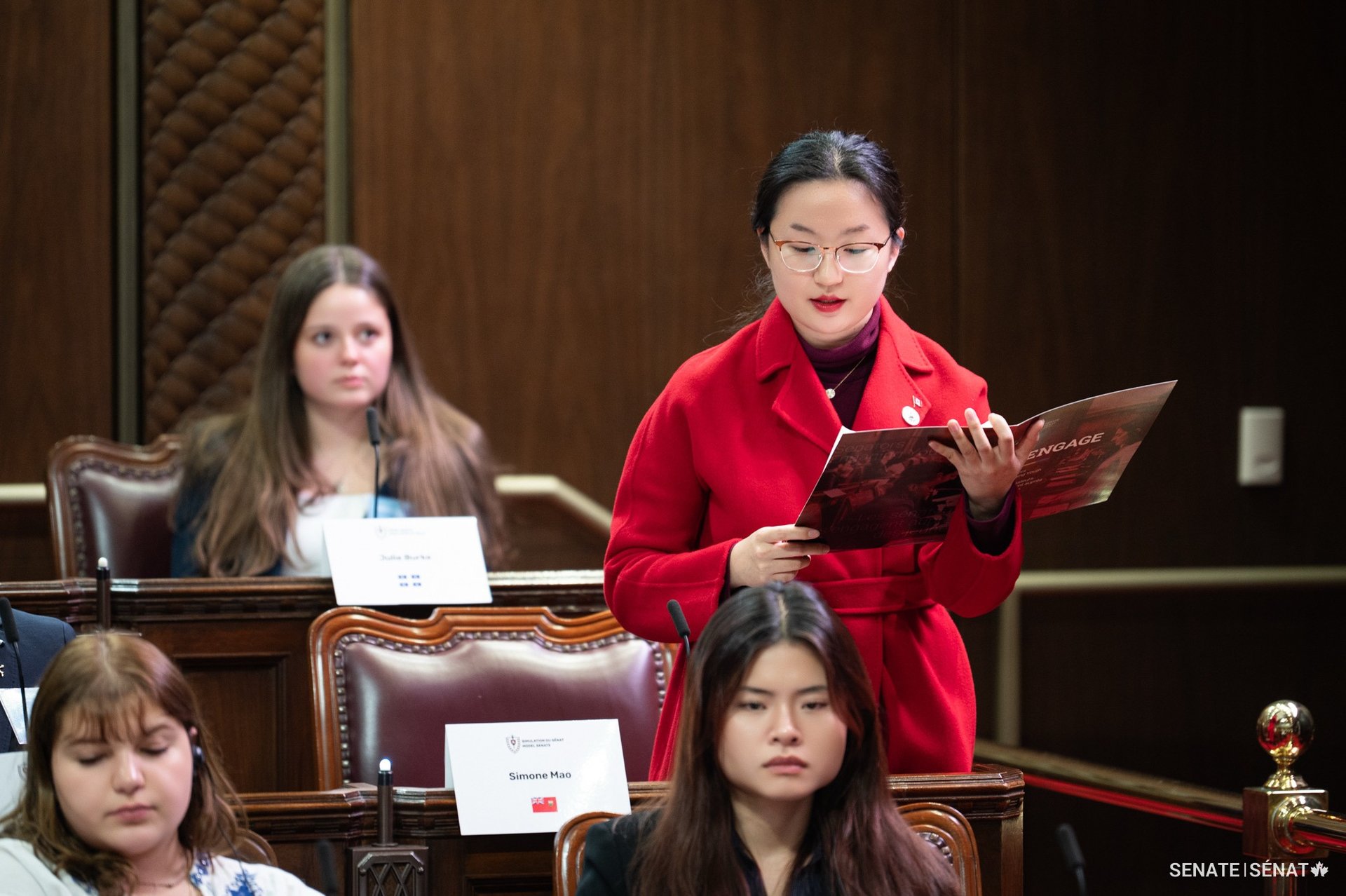
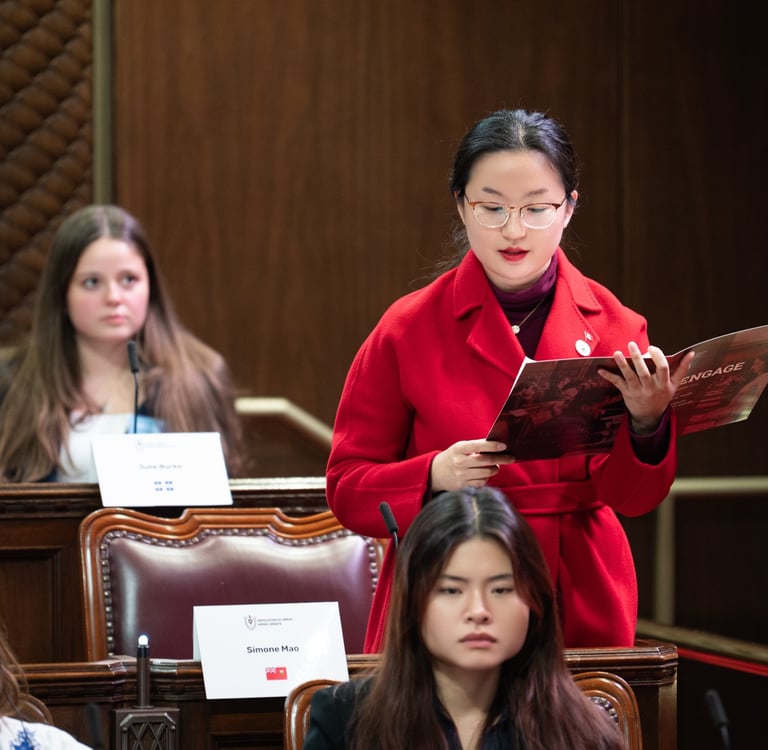
Simone spoke during the second reading. I had the honour of stepping into the role of a senator representing Ontario, engaging in legislative debates, policy discussions, and parliamentary simulations while learning firsthand how bills are examined, debated, and passed.
Model Senator, 2026. Photo credit to the Senate of Canada.
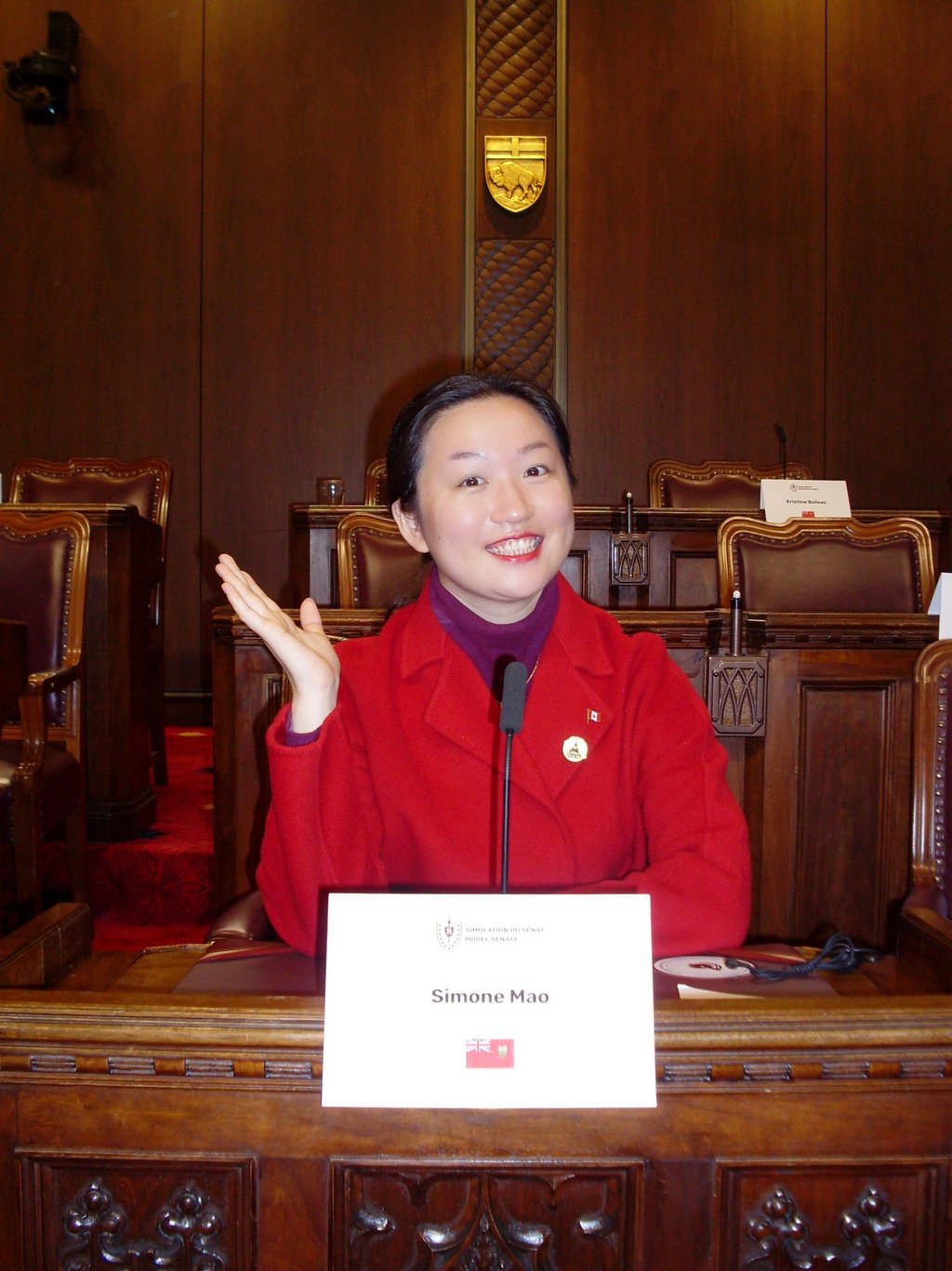
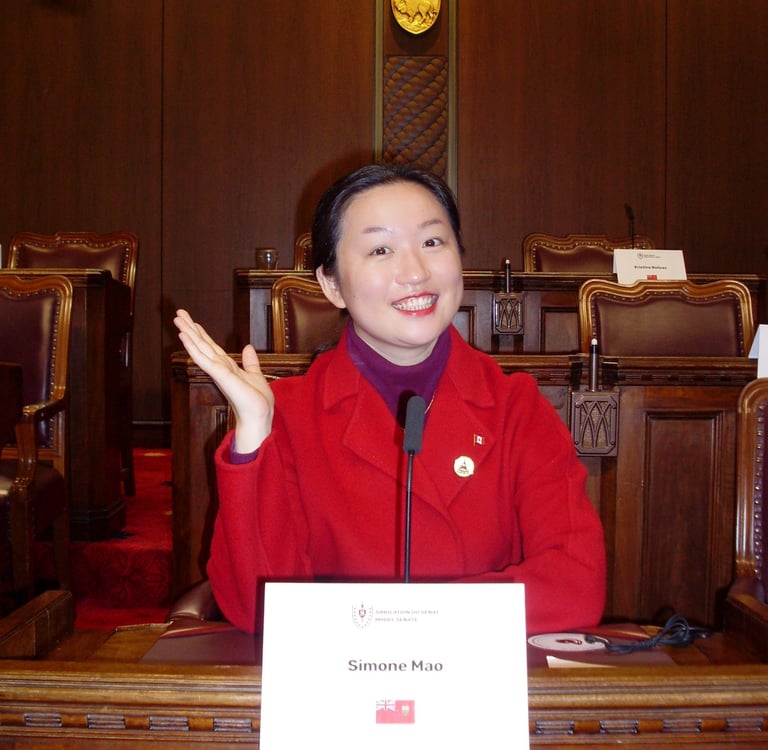
I bring to the Red Chamber a unique perspective shaped by intellectual origins, history, idealism, global migration, and an enduring commitment to democratic institutions. This is where my decade-long journey of searching for a truth that I can believe in has guided me.
As a Model Senator in the Senate of Canada, Simone debated legislation in the Red Chamber, engaged with Canadian senators on democratic governance, reconciliation, and public leadership, and delivered the closing vote of thanks to Senator Farah Mohamed, bringing her research in democratic theory, constitutionalism, and multiculturalism into parliamentary dialogue.
Youth Senator Mao representing Ontario in the Red Chamber, Senate of Canada.
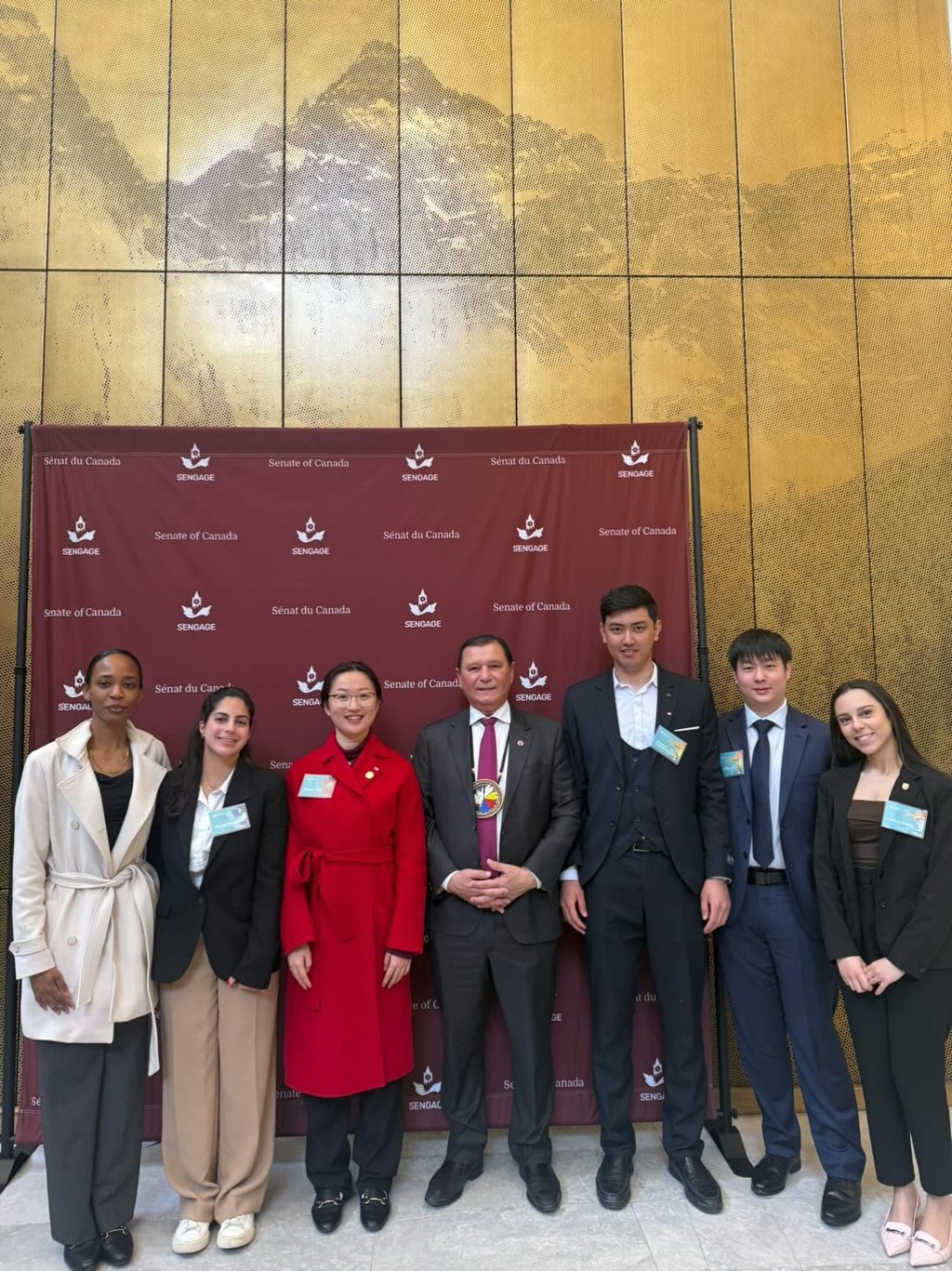
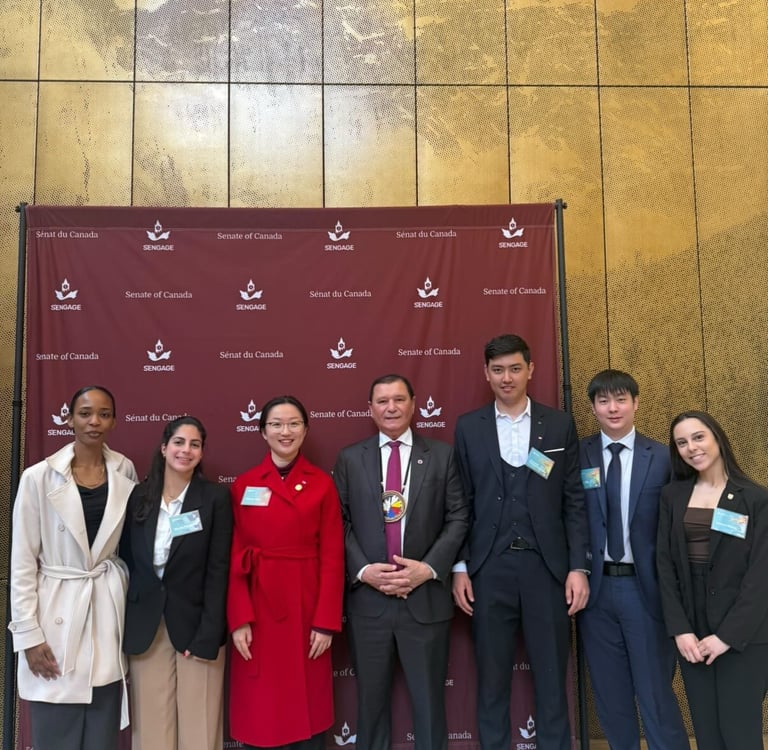
Simone with Lnu/Mi'kmaq Senator Brian Francis (Prince Edward Island), former Chief of the Abegweit First Nation, and fellow Youth Senators. It was an honour to discuss Indigenous reconciliation, the National Day for Truth and Reconciliation, and transitional justice. I also shared my research on Canadian multiculturalism and interest in Indigenous worldviews, while exchanging perspectives on Indigenous knowledge traditions and Harvard scholars' efforts to advance historical justice for Indigenous peoples in the Americas.
Model Senator, 2026. Photo credit to the Senate of Canada.
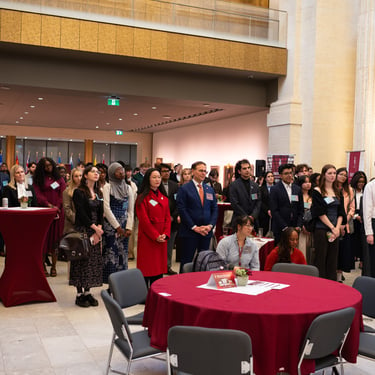
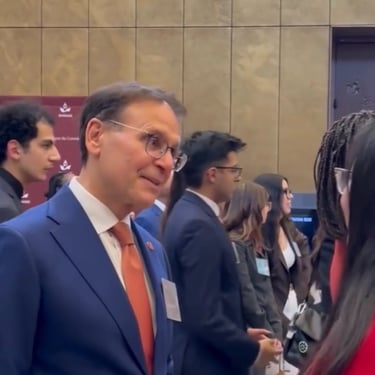
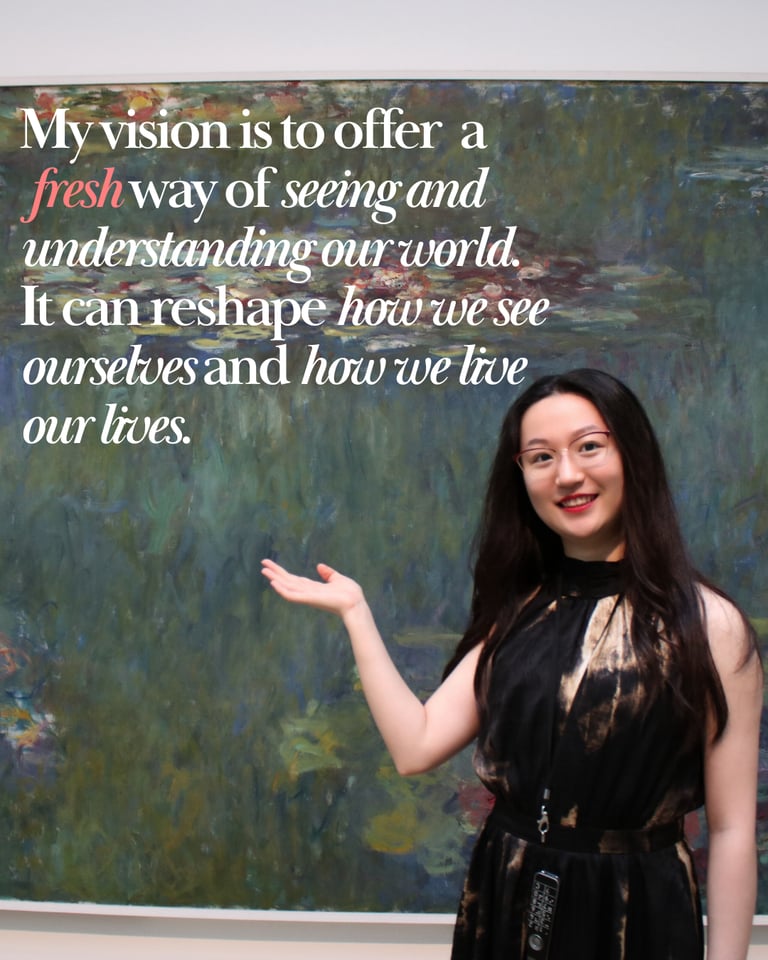
My vision is...
A future ahead in which people from different cultures, traditions, religions, and ways of life can live together peacefully in an increasingly plural, heterogeneous, multicultural (multi-ethnic), and interconnected world.
My work is ...
How can it be possible? What makes it possible? In which sense and to what degree?
“Given the opportunity, with the necessary conditions created, civilizations do not inevitably clash.”
If I had an hour to solve a problem and my life depended on the solution, I would spend the first 55 minutes determining the proper question to ask, for once I knew the proper question, I could solve the problem in less than five minutes.
Inquire. Investigate. Evolve.
Curiosity Sparks Reality.
Copyright © 202& Simone Zhenting Mao. All rights reserved.
The troops exulting sat in order round,
And beaming fires illumined all the ground.
As when the moon, refulgent lamp of night,
O’er heaven’s pure azure spreads her sacred light,
When not a breath disturbs the deep serene,
And not a cloud o’ercasts the solemn scene,
Around her throne the vivid planets roll,
And stars unnumber’d gild the glowing pole,
O’er the dark trees a yellower verdure shed,
And tip with silver every mountain’s head:
Then shine the vales, the rocks in prospect rise,
A flood of glory bursts from all the skies:
The conscious swains, rejoicing in the sight,
Eye the blue vault, and bless the useful light.
So many flames before proud Ilion blaze,
And lighten glimmering Xanthus with their rays.
The long reflections of the distant fires
Gleam on the walls, and tremble on the spires.
A thousand piles the dusky horrors gild,
And shoot a shady lustre o’er the field.
Full fifty guards each flaming pile attend,
Whose umber’d arms, by fits, thick flashes send,
Loud neigh the coursers o’er their heaps of corn,
And ardent warriors wait the rising morn.